

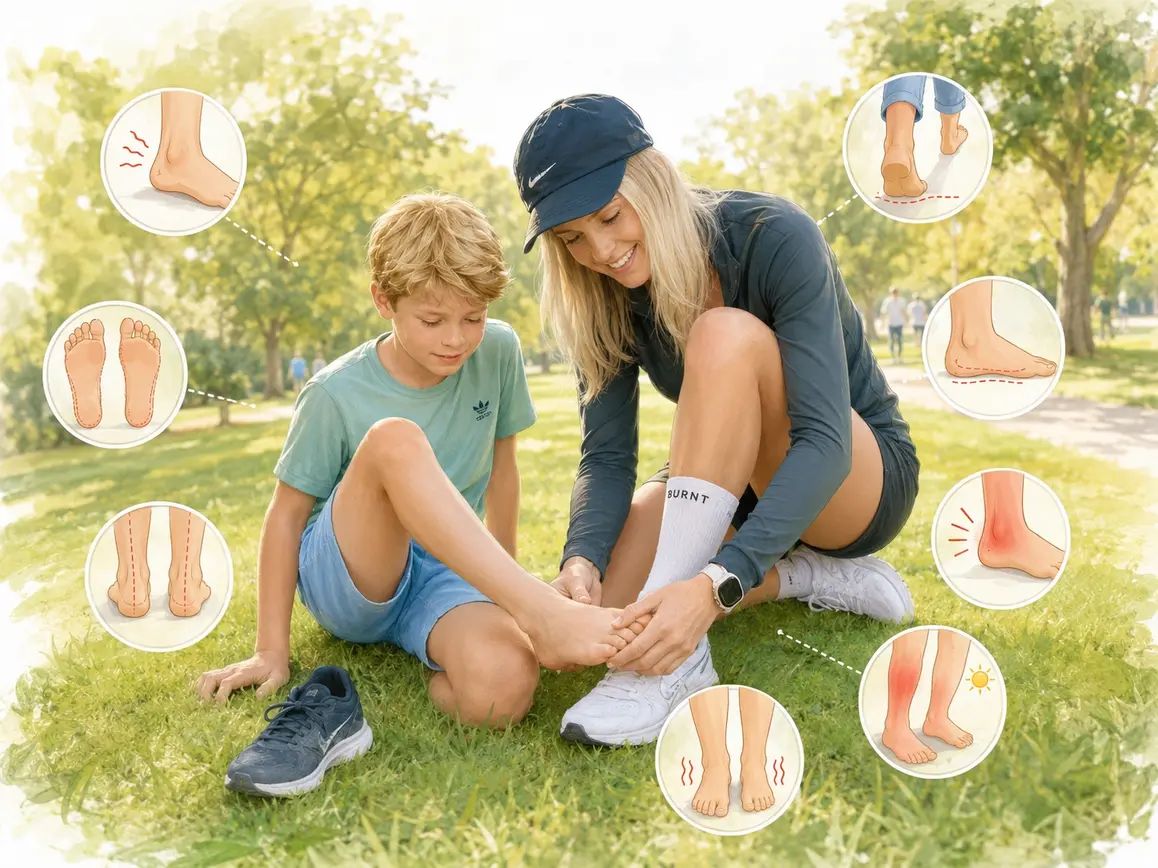
By Shenne’ Davies,The first time I noticed it, I convinced myself I had imagined it.
We were about fifteen minutes into one of our normal evening walks in Austin. Bentley and Harley had started the walk exactly as they usually did, moving faster than I wanted them to, talking over each other, stopping to point at things I would have walked straight past.
Then one of the boys slowed down.
Not dramatically. There was no fall, no crying, and no moment that clearly said something was wrong.
He simply started taking slightly shorter steps.
A few minutes later, he moved closer to me instead of racing ahead. Then came the sentence I did not pay enough attention to.
“My foot feels funny.”
I looked down at his sneaker and saw nothing obvious. The laces were tied. There was no blood, swelling, or torn sole.
I asked if it hurt.
“Not really.”
That answer was enough for me to keep walking.
Looking back, that was my first mistake.
I was waiting for a child to describe a physical problem using the clear language an adult might use. What he was actually giving me were small clues.
Daily Walks Are Usually the Easy Part of Our Day
I am Shenne’, a lifestyle and fashion creator, wife, and very proud mama to Bentley and Harley.
Our family lives in Austin now, although I spent the first thirteen years of my life in Savannah, Georgia. I still love the kind of ordinary outdoor time that does not need tickets, reservations, or a carefully packed bag.
Walking became one of those things for us.
Sometimes it is a proper family walk. Other times we are simply getting out of the house after I have spent too long working at my desk.
Bentley usually brings the energy.
If there is a path ahead, he wants to know where it leads.
Harley has his own way of taking in a walk. He notices smaller things, stops at different places, and somehow manages to turn a ten-minute route into something much longer.
That difference between them is one of the reasons I love writing about motherhood on FsiBlog. As I wrote in my Classroom 15x journey with Bentley and Harley, children can live in the same home and still experience the world in completely different ways.
Our walks had become normal enough that I thought I knew exactly how both boys moved.
That is probably why the small change eventually bothered me.
When I Decided His Foot Problem Was Worth a Doctor Visit
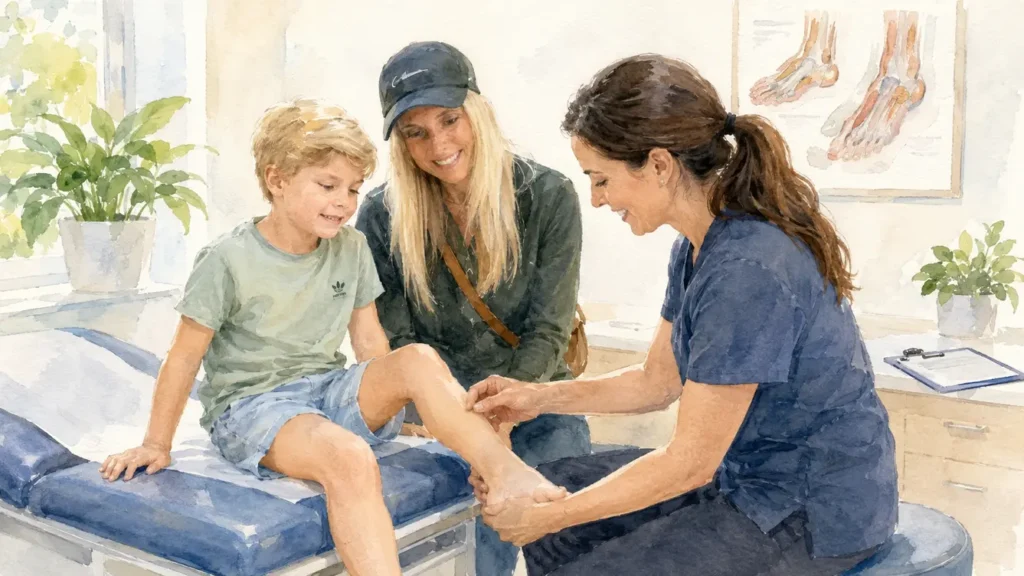
As a mom, I’ve learned that a small change in the way my boys walk or play can be worth paying attention to. If a foot problem keeps coming back, affects their daily activities, or simply doesn’t seem to be getting better, that’s when I feel it’s time to stop watching and make a doctor’s appointment.
If any of those sound familiar, getting a specialist opinion is absolutely the right move. Beaver Valley Foot Clinic’s children’s foot care covers everything from flat feet and heel pain to ingrown toenails and gait issues, and they work with kids specifically, which makes the whole experience a lot less daunting for little ones who are already nervous about the whole thing. A children’s foot assessment typically takes around 30 minutes and gives you a clear picture of what is happening and what, if anything, needs to be done about it.
I Made the Problem About Tiredness First
The next evening, it happened again.
We had not gone especially far, but one of the boys started falling behind.
I asked whether he was tired.
He shrugged.
I asked whether his foot hurt.
“Only a little.”
There was my second clue.
Instead of stopping there, I began creating explanations.
Maybe he had been running around more during the day.
Maybe the pavement was warm.
Maybe he was simply not interested in walking that evening.
Parents do this more than we admit. We have so much information coming at us that the ordinary explanation can feel more comforting than the uncertain one.
I knew children complain about being tired. I knew they sometimes decide halfway through an activity that they are finished.
What I did not yet know was whether this was actually tiredness.
The American Academy of Pediatrics tells parents that a limp can come from something minor, including a blister or a small injury, but an unexplained or persistent limp deserves attention because there are many possible causes. Their guidance for parents noticing a child limping changed the way I later thought about those first walks.
A child’s behaviour can be part of the symptom.
I had been listening only for the word “pain.”
The Shoes Gave Me Something Concrete to Blame
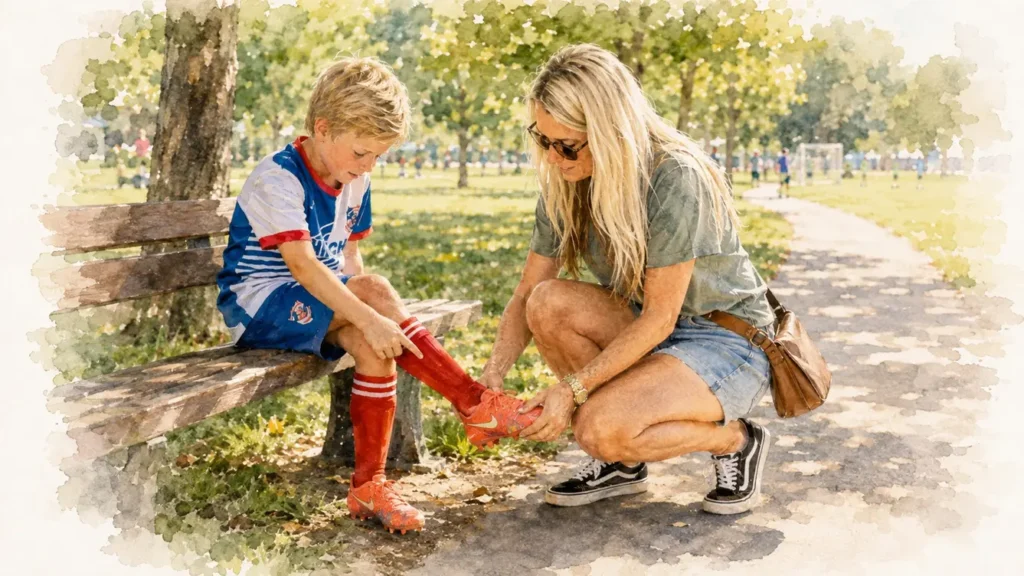
That weekend I checked the sneakers.
At last, I thought I had found the answer.
They looked more worn than I expected.
The front did not seem obviously tight, but children’s feet have an annoying habit of growing quietly. One day a pair fits, and not long afterward you are wondering how their toes ever fitted inside.
I pressed the toe area, checked the inside, and decided the shoes were probably the problem.
This felt reassuring because shoes were something I could fix immediately.
We went shopping.
I chose a pair that looked more supportive than the old ones. They had a thicker sole, more padding, and all the language parents like to see when they are trying to make a sensible purchase.
Comfort.
Support.
Cushioning.
I felt as though I had solved the problem before we reached the checkout.
I had not.
I Learned That Children’s Shoe Fit Is More Specific Than “Room to Grow”
I had always checked that there was space in front of the toes.
That was basically my entire shoe-fitting system.
The American Academy of Orthopaedic Surgeons recommends looking at more than length. Its guidance on finding properly fitting children’s shoes discusses width, a roomy toe box, and enough space for growth without simply putting children into oversized shoes.
The American Academy of Pediatrics also notes in its children’s shoe guidance that a child’s walking pattern, discomfort, or limp can sometimes tell parents more than the appearance of the shoe itself.
That mattered because I had been looking at the product instead of watching the child.
A technically decent shoe can still be the wrong width, shape, or size for a particular foot.
And a new shoe cannot fix a problem that was never caused by the old shoe.
The New Sneakers Did Not Change the Walk
The first walk in the new shoes started brilliantly.
I felt ridiculously pleased with myself.
Both boys were moving normally, and I silently decided the mystery had been solved.
Then, later in the walk, I saw the shorter step again.
This time I watched instead of immediately asking questions.
One step looked normal.
Then another.
Then there was a slight hesitation.
The change was subtle enough that I probably would not have noticed it if I had not been looking specifically for it.
I asked if we should turn around.
“Yes.”
That answer bothered me more than any complaint about the foot.
This was a child who normally negotiated for more time outside.
I stopped thinking about the shoe.
The Most Useful Thing I Did Was Film an Ordinary Walk
I did not want to stand behind my child saying, “Walk normally,” because children immediately stop moving normally when you say something like that.
Instead, I took a short phone video during an ordinary part of the next walk.
I filmed from behind and then from the side.
I did not try to diagnose what I saw.
That distinction became important.
A video can record a pattern. It cannot tell me why that pattern is happening.
When children’s foot or gait concerns are assessed, clinicians may watch how the child stands and walks as part of the examination. Children’s Hospital of Philadelphia describes gait observation as part of evaluating some pediatric foot problems, along with examination of strength, flexibility, alignment, and sometimes the wear pattern on a child’s usual shoes.
The video gave me something concrete to show rather than saying, “He walks strangely sometimes.”
It also helped me see that I was not imagining the change.
I wrote one sentence in my notes beneath 1.Anchor: noticing a pattern is useful, naming the cause yourself is not.
That became the main lesson of the whole experience.
I Deliberately Stopped Googling Possible Diagnoses
This may have been the hardest part.
Once you search “child foot pain when walking,” the number of possible explanations becomes enormous.
Some are small.
Some sound frightening.
Some pages make every symptom seem connected to one particular condition.
I caught myself comparing the boys’ feet, examining arches, looking at heel position, and trying to decide whether I could see something abnormal.
I stopped.
A child’s foot can look different during normal development without needing treatment. For example, Children’s Hospital of Philadelphia’s information on flat feet in children explains that flexible flat feet are common and often painless, while pain is one reason professional assessment may become appropriate.
The AAOS makes a similar distinction in its pediatric flexible flatfoot guidance, noting that persistent pain is a reason to speak with a doctor rather than assuming every flat-looking foot needs treatment.
I realised I could easily turn a normal feature into a diagnosis simply because I had started looking too closely.
I did not need to decide what kind of foot my child had.
I needed to explain what had changed.
I Am Keeping One Detail of This Story Private
I have talked openly about Bentley and Harley because being their mum shapes nearly everything I write.
Bentley came into my life and completely rewired it. He brings energy and endless curiosity into our home.
Then Harley came along and somehow stretched my heart again. He has his own softer way of moving through our family while still having plenty of personality.
Together, they are the reason so many FsiBlog stories begin with something that happened in our ordinary day.
But I am intentionally not telling you which boy had the foot concern in this story.
That is not an accident.
As they grow, I am becoming more aware that being a lifestyle writer does not give me ownership of every private detail of their lives.
I can share what motherhood taught me without attaching one child’s name permanently to a health concern.
That is a boundary I wrote about in My Classroom 15x Journey as a Mom to Bentley and Harley. My children are central to my story, but they also deserve stories that belong only to them.
So I will keep calling him “one of the boys” here.
The lesson works exactly the same.
The Pediatrician Asked Better Questions Than I Had
When I finally raised the issue professionally, the questions were not dramatic.
When did I first notice it?
Was it every day?
Had there been a fall?
Did discomfort happen during the walk or afterward?
Was it always the same foot?
Was there swelling?
Did he avoid activities he normally enjoyed?
Did it happen without shoes?
Those questions immediately showed me what had been missing from my own investigation.
I had been trying to answer “What is wrong with his foot?”
The better first question was “What exactly has changed?”
The NHS gives parents similar advice in its current guidance about limping in children. It notes that an unexplained limp should be medically checked rather than self-diagnosed, and it identifies inability to bear weight, worsening symptoms, significant pain, fever or feeling unwell among reasons for more urgent assessment.
That is very different from assuming every unusual step is an emergency.
It is also very different from ignoring a repeat pattern because the child can still walk.
The Appointment Made Me Stop Looking for One Universal “Good Shoe”
Before this experience, I thought children’s shoes fell into two groups.
Good supportive shoes and bad flimsy ones.
Real feet are not that simple.
A child’s foot shape, activity, size, and any actual medical needs affect what feels comfortable.
Stanford Medicine Children’s Health notes in its overview of foot pain and footwear that poorly fitting shoes can worsen foot irritation and pain, while symptoms themselves can have many possible causes that require proper diagnosis.
That completely changed the way I shop.
Now, “supportive” on a product page is not enough.
I look at whether the child’s toes have room.
I notice width.
I look for rubbing.
I check whether the heel is sliding.
I ask how the shoe feels after walking rather than only when it is first put on.
Most importantly, I do not expect the shoe salesperson to diagnose a medical problem.
A knowledgeable fitter can help with shoe size and fit.
That is a different job from evaluating why a child is changing the way he walks.
I Nearly Bought Inserts Before Anyone Had Recommended Them
During my internet research, I found children’s insoles everywhere.
Arch support.
Heel support.
Corrective support.
The language made them feel like an obvious next step.
I put a pair in an online basket and nearly ordered them.
Then I stopped.
If I did not know what was causing the discomfort, what exactly was I correcting?
The American Academy of Pediatrics points out in its discussion of flat feet in children that painless flexible flat feet generally do not need treatment and that inserts do not make a normal child’s arch develop.
That was useful commercial information.
I had assumed there could be little downside to adding more support.
But buying a medical-looking product without knowing whether it addresses the actual issue is still guessing.
I removed the inserts from the basket.
Our Walks Became Shorter for a While
This was probably the least exciting part of the story.
I did not create a special walking program.
I did not tell him to push through because exercise is healthy.
I did not turn every outing into a test.
We simply reduced the distance while the concern was being assessed and followed the advice we were given.
I paid attention to whether normal activity was comfortable.
That was enough.
There is a big emotional temptation as a parent to keep checking.
“Does it hurt now?”
“What about now?”
“Walk over there so I can watch you.”
I realised I was in danger of making one child’s foot the main subject of every family walk.
I did not want that.
The purpose of our walks had always been family time.
As I wrote in my family lifestyle and travel reflections, the small details often decide whether an outing feels good for children. Rest, food, comfort, weather, and the freedom to leave early matter more than forcing the original plan.
The same rule applied around our own neighborhood.
Turning around early was not a failed walk.
Children’s Pain Does Not Always Arrive as a Clear Complaint
This was probably the biggest parenting lesson for me.
I expected pain to sound like:
“My foot hurts.”
Instead, it looked like slowing down.
Wanting the walk to end.
Changing a step.
Staying closer to me.
Mentioning that something felt “funny.”
Children’s Health notes that children can express musculoskeletal discomfort through changes in movement, limping, weakness, avoiding certain motions, or difficulty doing normal activities, not only through a detailed description of pain. Its pediatric musculoskeletal pain guidance explains why observation becomes especially useful when children cannot fully describe what they feel.
That is something I now apply beyond feet.
Bentley and Harley are getting better at telling me what they feel, but they are still children.
Sometimes behaviour gives me the first sentence.
I Also Learned Not to Call Everything Growing Pains
“Maybe he’s growing.”
I said that more than once.
It is such an easy explanation because children are, obviously, growing.
But growth should not become a label parents place on every recurring ache or unusual movement.
The American Academy of Pediatrics explains in its information about so-called growing pains that growth itself is not considered the cause of these aches. It also lists limping, swelling, severe pain, fever and other concerning signs as reasons to contact a pediatrician.
I had been using “growing pains” to mean “something children sometimes get.”
That was not precise enough.
A repeat change deserved its own attention.
The Old Shoes Still Told Us Something Useful
Although the shoes did not give me the diagnosis I thought they would, I am glad I kept them.
Worn shoes can provide information about how they fitted and how they were being used.
I could compare them with the new pair.
I could see places where the inside lining had rubbed.
I could check whether one sole looked different from the other.
Those observations were worth showing rather than trying to interpret alone.
When I now buy shoes for Bentley and Harley, I do not throw the previous pair away immediately if there has been a fit concern.
I keep them for a little while.
That is different from deciding that every uneven sole means a physical problem.
Shoes are clues, not diagnoses.
Our Montshire Day Made Me Think About It Again
Family outings show you how differently children move when they are interested.
During experiences like our family day at the Montshire Museum of Science, Bentley and Harley can move between activities without thinking about exercise at all.
They are too busy investigating.
That helped me notice something important.
Instead of asking only whether a foot bothered a child during our official “walk,” I needed to think about movement across the whole day.
Was he avoiding running?
Was he choosing not to climb?
Was he asking to sit during activities he normally enjoyed?
Or was the issue limited to one pair of shoes or one type of activity?
Those differences are far more useful to tell a professional than my opinion about what the foot looked like.
I Stopped Inspecting the Boys Against Each Other
Having two children creates a very tempting control group.
I could look at Bentley’s feet and then Harley’s.
One arch looked different.
One shoe sat differently.
One child naturally stood another way.
I had to stop.
Siblings do not need to have matching feet or matching movement.
The question was not whether one child looked like the other.
It was whether something had changed for that child.
This is a parenting lesson I seem to keep learning in different forms.
Comparison feels useful because it creates an easy standard.
It can also distract me from the person directly in front of me.
I Would Handle the First Walk Differently Now
If I could return to that first Austin walk, I would not panic.
I would not start testing his foot on the pavement.
I also would not immediately assume he was simply tired.
I would stop and listen.
I would ask where the strange feeling was without feeding him possible answers.
I would check the shoe for an obvious pebble, rubbing spot, blister, or other visible problem.
If he wanted to turn around, we would turn around.
Then I would watch what happened afterward.
If the change repeated, if he developed a limp, if pain persisted, or if normal activity became difficult, I would raise it with his pediatrician rather than continuing my own investigation.
That matches the AAP’s current parent guidance that persistent limping or difficulty returning to ordinary activity warrants professional evaluation rather than repeated guesswork at home.
And if a child suddenly could not bear weight, was very unwell, developed severe worsening pain, significant swelling or another concerning symptom, I would seek prompt medical care.
The Walks Feel Ordinary Again
That is probably my favorite part of this story.
Our walks went back to being walks.
I am not spending the entire time staring at feet.
Bentley can race ahead.
Harley can stop for whatever tiny thing has captured his attention.
I can listen to both of them talk at once and pretend I am somehow following both conversations.
The experience did leave me with one new habit.
Every now and then, I watch them walk.
Not because I expect a problem.
Because motherhood has taught me that ordinary routines create a baseline. You begin to know how your children move through the world.
That makes small changes easier to notice.
I used to think being a good mum meant knowing the answer.
This experience reminded me that sometimes the better parenting skill is noticing that I do not know the answer yet.
I can observe.
I can listen.
I can keep a short video.
I can bring the old shoes.
And then I can hand the question to someone qualified to answer it.
That is a much quieter kind of confidence than the version of me who walked into the shoe shop convinced a thicker sole was going to fix everything.
But I trust it much more now.