
By Shenne’ Davies
The night I decided to “balance all seven chakras,” I somehow turned yoga into another task I could fail.
It was almost 9 p.m. Bentley and Harley were finally settled, the living room was quiet, and I rolled my mat onto the floor with my phone propped against a candle jar.
I had saved a seven-chakra yoga routine earlier that week.
Root chakra. Sacral chakra. Solar plexus. Heart. Throat. Third eye. Crown.
Seven chakras meant seven poses, and in my head that somehow meant I needed to perform every pose properly before I could call the practice complete.
Twenty minutes later, I was attempting a backbend that was much deeper than anything I normally practised.
My arms were shaking.
My breathing had stopped being calm.
I was thinking more about whether my body looked like the reference photo than about why I had stepped onto the mat in the first place.
I came out of the pose, sat down, and laughed at myself.
I had started yoga because I wanted a quieter mind.
I had managed to turn it into an exam.
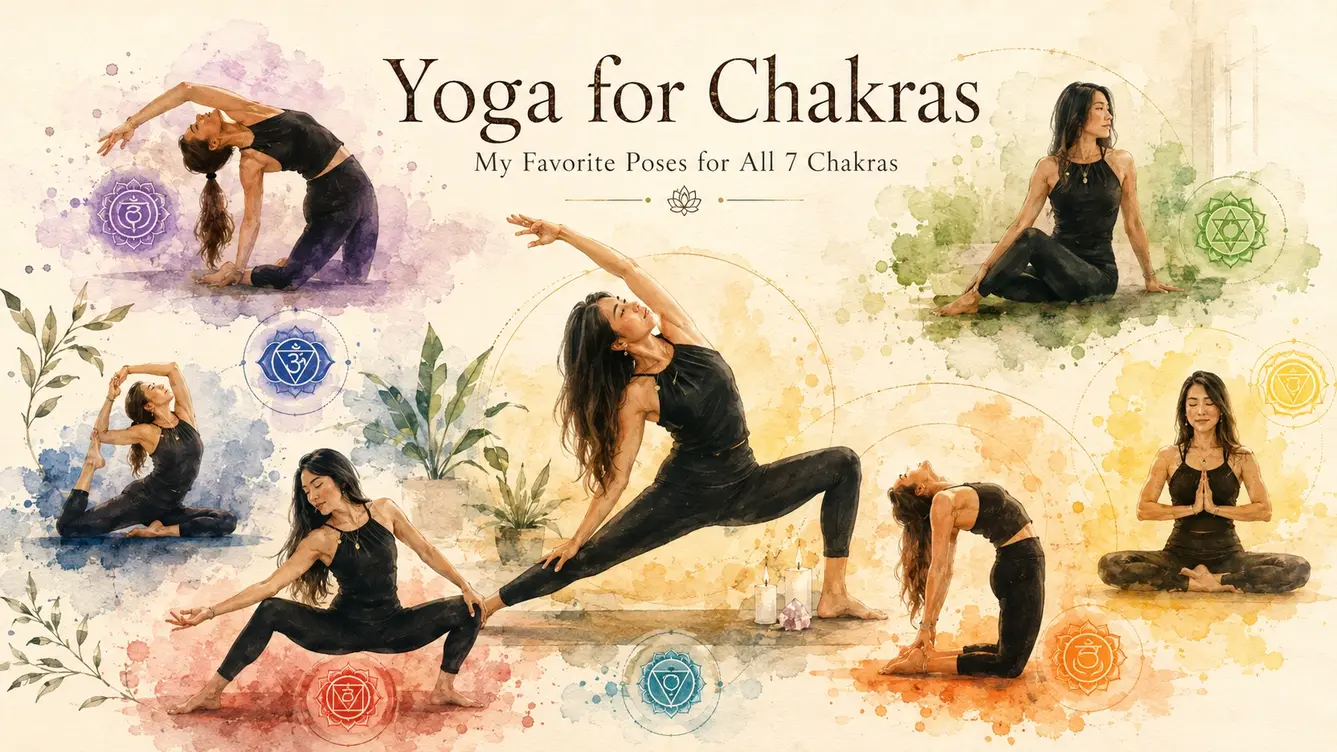
That evening completely changed the way I use yoga for chakras.
I Needed to Understand What Chakras Were Before Trying to “Fix” Them
I should make an important distinction before going any further.
I enjoy the chakra system as a traditional spiritual and reflective framework. I do not treat chakras as medically proven organs or use them to diagnose physical or mental health problems.
The word chakra comes from a Sanskrit term associated with a wheel, and chakra concepts developed within South Asian spiritual and yogic traditions. Different traditions have described subtle-body systems in different ways, so even the familiar seven-chakra model should not be treated as the only version that has ever existed. This overview of the chakra concept and its religious background helped me understand that the history is much richer than the colorful diagrams I first saw online.
Modern yoga teaching often uses a seven-chakra framework running from the root chakra through the crown chakra. Yoga Journal’s introduction to using the seven chakras in yoga practice describes the common symbolic themes associated with each one.
That is the framework I use here.
The poses do not medically “open” an organ.
For me, they give each part of a yoga session a theme.
Grounding.
Creativity.
Confidence.
Compassion.
Expression.
Reflection.
Stillness.
Once I understood that difference, the practice became much more meaningful.
I Had Been Using Difficult Poses as Proof
That failed evening exposed something I had not wanted to admit.
I thought the more advanced pose was automatically the more spiritual pose.
If a chakra sequence showed Wheel Pose for the heart chakra, I assumed my supported backbend was somehow the weaker version.
If someone balanced perfectly in Tree Pose, I wanted my foot higher.
If a photograph showed a deep hip opener, I thought I needed the same depth.
I was using shape as a score.
Yoga does not need that.
The National Center for Complementary and Integrative Health says yoga is generally considered safe for healthy people when practised properly, but injuries can occur. It specifically recommends appropriate instruction, and notes that people with certain health conditions may need to modify or avoid particular poses. Its evidence-based overview of yoga safety and benefits became one of the sources I now return to when wellness advice starts sounding too absolute.
MedlinePlus makes the same practical point in its guide to yoga for health: poses can be modified, and people who are pregnant or who have certain health conditions or injuries may need individual guidance.
So I changed the rule.
I wrote 1.Anchor in my yoga notes: if I cannot breathe comfortably and stay in control, I do not need a deeper version just because somebody else can do it.
That rule has made yoga much more useful to me.
My Root Chakra Pose Became Mountain Instead of Something Impressive
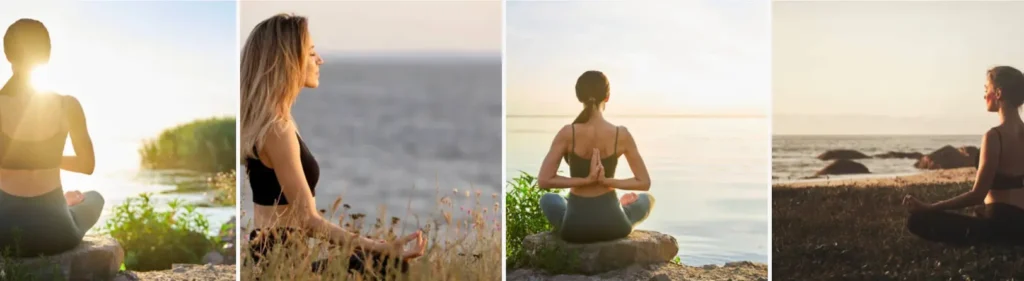
The root chakra, or Muladhara, is commonly connected in modern chakra practice with grounding, stability, and feeling supported.
At first, I chose Tree Pose because balancing on one leg seemed more meaningful.
The problem was that I spent the entire pose worrying about falling.
That did not feel particularly grounding.
My favorite root chakra pose eventually became Mountain Pose.
It looks almost too simple.
I stand with both feet connected to the floor, let my arms rest naturally, soften my knees instead of locking them, and notice how my weight is distributed.
That is it.
Yet on days when I have been working at my desk, answering messages, thinking about dinner, listening to Bentley and Harley, and mentally jumping between ten things, standing still can feel surprisingly powerful.
Johns Hopkins includes yoga among activities that can support strength, balance, flexibility and relaxation. Its overview of evidence-supported yoga benefits even uses Tree Pose as an example of balance work.
I still practise Tree Pose sometimes.
I simply stopped believing that wobbling meant the root chakra session had failed.
Some evenings Mountain Pose gives me exactly the feeling I was looking for: both feet down, nowhere else to go for a minute.
The Sacral Chakra Taught Me to Stop Forcing My Hips
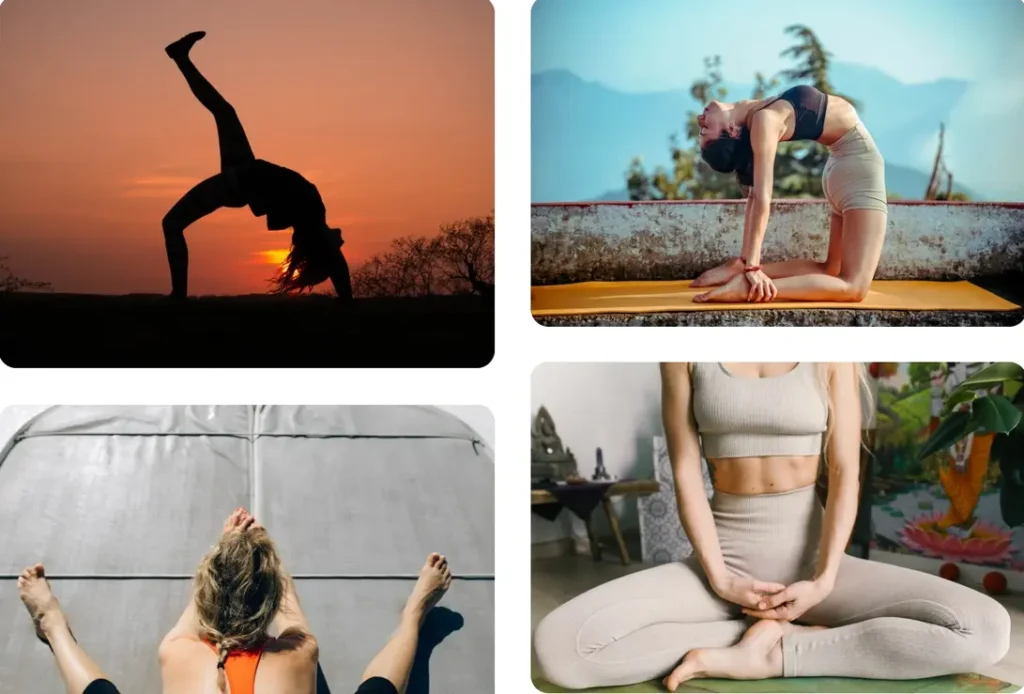
My first sacral-chakra practice involved a deep squat.
The sacral chakra, Svadhisthana, is commonly connected with creativity, emotion and the pelvic area within contemporary chakra teaching. Yoga traditions often pair it with hip-opening movements, squats and lunges.
I saw a photograph of a beautiful deep Malasana and wanted to sit exactly that low.
My heels lifted.
My back rounded.
I pushed my knees farther apart.
The pose felt like an argument.
That was the opposite of what I wanted from a practice associated with flow.
Now my favorite option is a supported Low Lunge.
I keep the movement comfortable. My hands may stay on blocks or my front thigh rather than reaching dramatically overhead.
Sometimes I make small movements instead of holding a fixed position.
The important change was allowing the pose to fit my body rather than forcing my body into the picture.
Cleveland Clinic’s current guidance on using yoga blocks, bolsters and other props explains that props can provide stability, support and comfort rather than making a pose somehow less legitimate.
That helped remove a strange little piece of pride I had around using blocks.
A block does not mean I failed to reach the floor.
It means I brought the floor closer.
My Solar Plexus Pose Changed the Way I Think About Strength
The solar plexus chakra, Manipura, is usually associated in modern chakra practice with confidence, will, purpose and personal power.
Naturally, I thought this required the hardest abdominal pose possible.
I chose Boat Pose.
There is nothing wrong with Boat Pose when it suits the person practising it. Yoga Journal also commonly connects it with the solar plexus chakra.
My mistake was turning shaking into a competition.
I would hold the pose after my form had started falling apart because I wanted to prove something.
Eventually, I replaced that mindset with Chair Pose as one of my favorite solar plexus choices.
Chair still asks me to use my legs and trunk.
But I can adjust the depth.
I can place my hands at my chest instead of reaching overhead.
I can come out when my form stops feeling controlled.
The lesson was bigger than one posture.
Confidence did not have to mean staying in a position after my body had clearly asked me to change it.
Sometimes confidence is deciding that enough is enough.
This is close to the lesson I learned during Casey’s 30 Day Stretches to Splits Journey. That story also moved away from using maximum range as the only proof of progress.
My Heart Chakra Practice Used to Hurt My Back
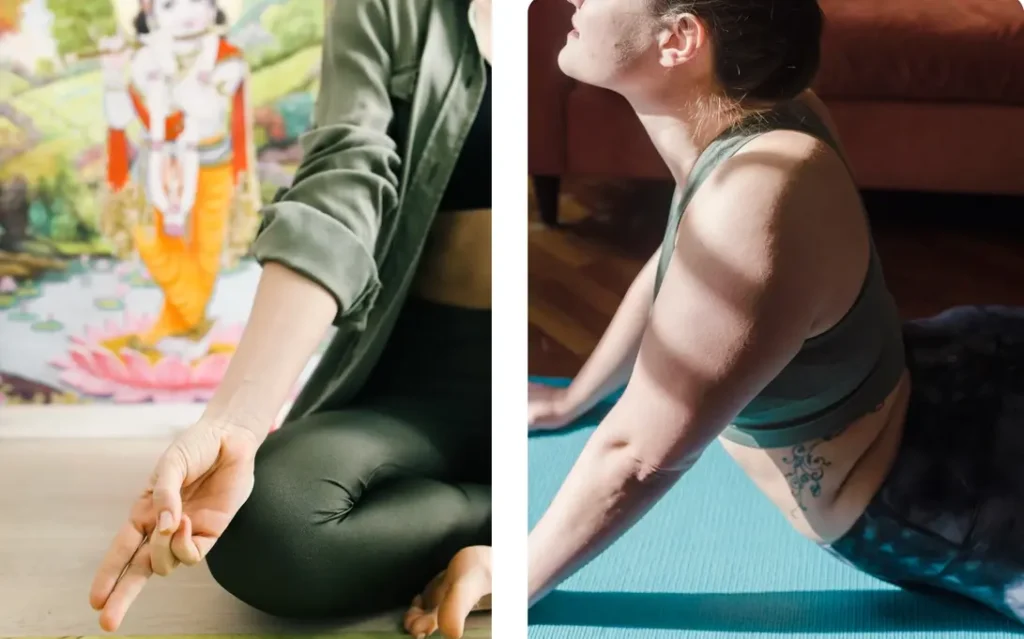
The heart chakra, Anahata, is traditionally placed around the heart or chest area within the seven-chakra model and is commonly linked with compassion, love and openness.
This was the chakra that caused my original failure.
I had seen Full Wheel used in heart-opening chakra sequences.
So I assumed a proper heart chakra practice required a dramatic backbend.
It did not.
The pose made me so concerned about my arms, wrists and back that I had no attention left for breath or reflection.
Now one of my favorites is Sphinx Pose.
I lie on my stomach with my forearms supporting me and gently lift through my chest.
The shape is much smaller than Wheel.
For me, that is exactly why it works.
I can breathe.
I can notice the front of my chest without turning the movement into an athletic test.
On another day, I may use a supported reclined position with cushions.
Yoga can contribute to flexibility, strength, balance and general wellbeing, but Harvard Health also stresses that pose quality and safe progression matter more than pushing as far as possible. Its discussion of yoga beyond simple flexibility is useful context when yoga starts becoming more about appearance than function.
My heart chakra pose became gentler when I stopped asking it to prove how flexible my spine was.
The Throat Chakra Made Me Notice Something Other Than My Body
The throat chakra, Vishuddha, is commonly associated with communication and expression within contemporary chakra frameworks.
My favorite practice here is not the deepest neck position I can find.
It is a comfortable Supported Bridge Pose followed by a few quiet breaths.
I keep my neck neutral rather than turning my head.
The pose gives me a small opening through the front body, but the part I value most happens afterward.
I ask myself one question.
What have I been avoiding saying clearly?
Sometimes the answer is nothing important.
Sometimes it is that I need help.
Sometimes it is that I agreed to something I did not really have time for.
Sometimes it is that I have been saying “I’m fine” because explaining the real answer would take longer.
That reflection makes the throat-chakra idea useful to me.
It is not because Bridge Pose physically unlocks communication.
The pose creates a quiet moment in which I think about communication.
That difference matters.
Yoga is a mind-body practice that commonly combines physical postures with breathing and attention. MedlinePlus describes yoga as movement joined with focused breathing and meditation, which is much closer to how I now use it than treating individual shapes like switches.
Child’s Pose Became My Third Eye Pose
The third eye chakra, Ajna, is associated in chakra traditions with intuition, insight and inner awareness.
I originally thought this section needed a complicated meditation.
Instead, my favorite pose became Child’s Pose.
I lower myself toward the mat and support my forehead if I need to.
Sometimes that means the floor.
Sometimes it means a block or folded blanket.
The point is not how low I can go.
The point is that my eyes are no longer looking around the room.
This is one of the few moments in the day when I intentionally remove visual information.
No phone.
No laptop.
No laundry waiting in the corner of my eye.
No checking whether somebody has sent me a message.
That physical reduction in stimulation makes the reflective theme of the third eye chakra feel useful to me.
Cleveland Clinic’s home-yoga guidance recommends beginning with accessible poses and having enough clear space to practise safely. Its updated advice for practising yoga at home also stresses that beginners do not need complicated equipment or advanced shapes to begin.
Child’s Pose reminds me of that every time.
Simple does not mean pointless.
I Stopped Trying to Find a Spectacular Crown Chakra Pose
The crown chakra, Sahasrara, is associated in the familiar seven-chakra system with spiritual connection, consciousness and something beyond the individual self.
When I first started reading chakra yoga articles, I expected the final pose to be the most advanced one.
Instead, one traditional modern pairing kept appearing that made far more sense to me.
Savasana.
Rest.
Yoga Journal includes Savasana as a crown-chakra pose in its beginner chakra sequence.
That almost felt like a joke after I had spent so much energy trying to make the practice difficult.
I lie on the mat.
I let my arms rest.
I stop trying to improve anything for a few minutes.
Those last words are important.
As a mum, a wife, a writer and someone who spends a ridiculous amount of time thinking about the next thing that needs doing, stopping improvement can be surprisingly uncomfortable.
There is always another task.
A page can be edited.
A room can be tidied.
An email can be answered.
A plan can be improved.
Savasana asks me to stay where I am.
That may be my favorite chakra practice of all.
I Never Actually Needed Seven Difficult Chakras Poses
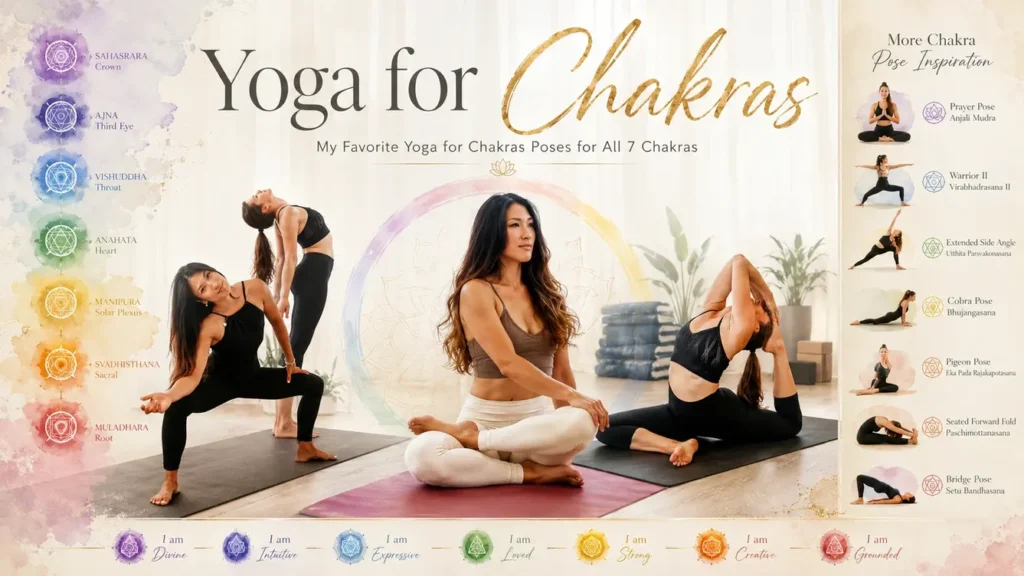
The routine I practise now can look almost embarrassingly simple compared with my first attempt.
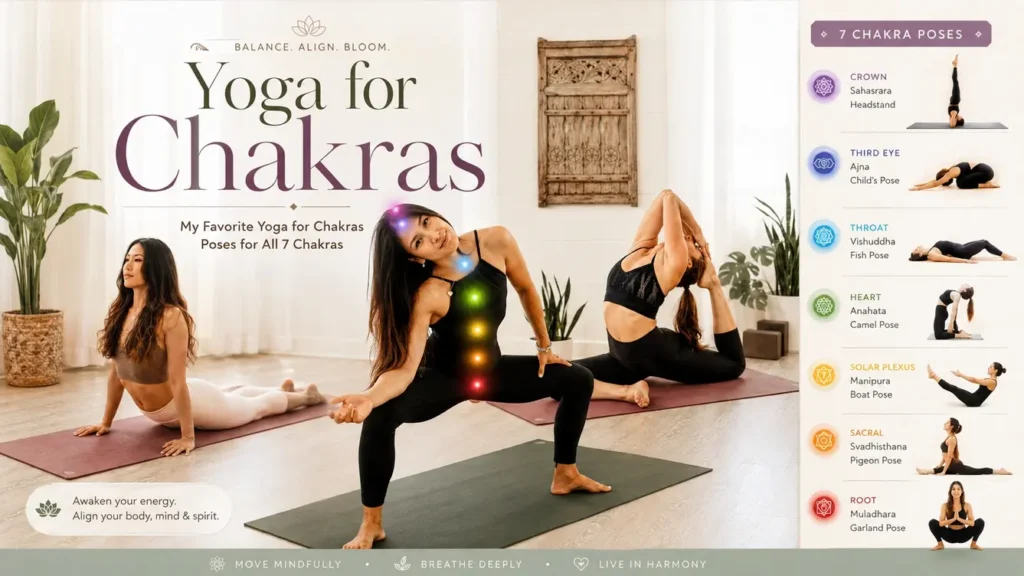
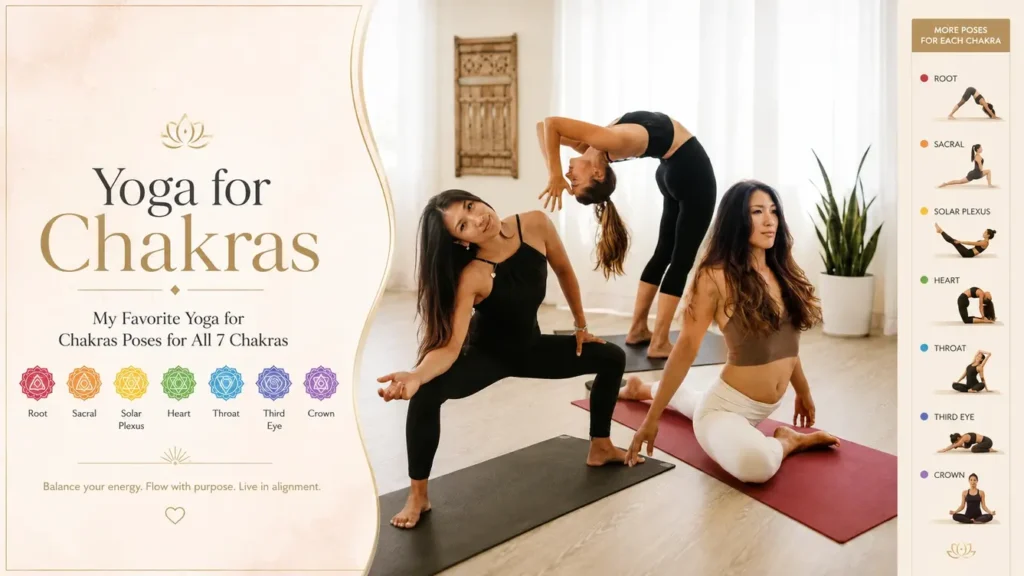
My seven favorites are:
Root: Mountain Pose
Sacral: Supported Low Lunge
Solar Plexus: Chair Pose
Heart: Sphinx Pose
Throat: Supported Bridge
Third Eye: Child’s Pose
Crown: Savasana
I sometimes change them.
That is important.
There is no scientific rule saying one exact posture must correspond to one exact chakra, and even contemporary yoga teachers use different pose associations. Yoga Journal’s chakra resources show several different sequences in which the poses linked with individual chakras vary.
The theme matters more to me than creating an official chart.
Some mornings my root practice is Tree.
Sometimes my heart pose is a gentle Cobra.
Sometimes I skip the physical pose entirely and sit quietly.
That flexibility stopped chakra yoga from becoming another routine I had to perform correctly.
Breath Became More Important Than Depth
The biggest difference between my first chakra session and the way I practise now is easy to hear.
I breathe.
During that failed backbend, I had held my breath while trying to stay in position.
Now I use breathing as a check.
If I become so strained that my breathing turns sharp or I cannot maintain the position comfortably, I make the pose easier or come out.
I do not use breathing exercises to treat a medical problem, and I do not believe a certain number of breaths unlocks a chakra.
I simply use the breath to bring attention back to the present moment.
Mindfulness and meditation practices have been studied separately from chakra claims. NCCIH’s review of meditation and mindfulness research notes possible benefits for stress and quality of life while also pointing out that evidence varies by condition and study.
That is the level of claim I am comfortable making.
Sometimes slowing down helps me feel calmer.
I do not need to turn that experience into a medical promise.
Props Made My Practice Better, Not Easier in a Bad Way
I used to move yoga blocks out of the frame when I photographed my mat.
I thought they made me look inexperienced.
Now I leave them there.
Blocks help me support my hands in lunges.
A folded blanket can make kneeling more comfortable.
A cushion can support my chest or knees.
A wall can help with balance.
Cleveland Clinic specifically recommends yoga props as tools for support, stability and comfort.
That changed my buying decisions too.
I do not need a large collection of spiritual accessories to practise chakra yoga.
My useful items are boring:
A mat that does not slide easily.
Two stable blocks.
A blanket.
Sometimes a strap.
Comfortable clothes.
That is enough for my home practice.
A seven-piece crystal set, special chakra mat or color-coded clothing may be meaningful to someone who enjoys those things, but none is required to perform yoga poses.
The physical practice should still work without the shopping list.
I Became More Careful About Practising Alone
There are endless yoga videos online, and that convenience is part of why I practise at home.
It also makes it easy to attempt something beyond my experience because the instructor on the screen makes it look simple.
NCCIH notes that yoga injuries are usually minor, with sprains and strains among the more common problems, but it also advises beginners to learn under appropriate guidance and modify practices when necessary.
When I want to learn a position that feels technically difficult, I no longer rely only on a short clip.
A qualified teacher can see things I cannot see from inside my own body.
Yoga Alliance maintains a directory for finding yoga teachers and describes its registered teacher framework as including training in yoga techniques, philosophy, anatomy and teaching methods.
A credential alone cannot guarantee that every teacher will be the right match, but asking about training and experience is more useful than choosing someone only because their poses look impressive online.
I Don’t Make Bentley and Harley “Balance Their Chakras”
The boys sometimes wander into the room while I am practising.
Usually the quiet session stops being quiet very quickly.
Bentley may want to copy a balance.
Harley may create an entirely new pose that definitely did not appear in any yoga book.
I let it stay playful.
I do not tell them that feeling sad means one of their chakras is blocked.
I do not use chakra ideas to explain a health symptom or behaviour.
If they join me, the focus is ordinary movement, balance, breathing and having fun.
Cleveland Clinic’s guidance about yoga for children makes one rule especially clear: children’s yoga should not hurt, and movement should remain appropriate to the child rather than becoming a flexibility contest.
That suits the atmosphere I want at home.
Sometimes a yoga pose can just be a yoga pose.
Chakra Yoga Became a Better Form of Self-Care When I Stopped Trying to Measure It
I used to finish the sequence and ask myself whether I felt different.
Was my heart more open?
Was my root chakra balanced?
Did I feel more intuitive?
Those questions made me search for an experience I thought I was supposed to have.
Now I use much simpler questions.
Did I take a few minutes away from the screen?
Did I move without hurting myself?
Did I breathe?
Did I notice what was happening in my body and mind?
Do I feel ready to return to my evening?
That approach fits much better with the FsiBlog idea of simple mind-body practices for emotional wellbeing, where gentle movement is one option among several ways people may create a calmer routine.
It also connects with what I have learned about daily self-care that respects your actual limits. Self-care becomes much less useful when I turn it into another standard I have to meet.
My Seven Chakras Practice Looks Very Different Now
If you had seen my first attempt, you would have seen a woman trying very hard to make yoga look correct.
My knees were forced farther than they needed to go.
My backbend was too ambitious.
My phone was positioned where I could keep checking the reference photographs.
I completed seven poses.
I did not feel particularly peaceful afterward.
Now I may stand in Mountain Pose for the root chakra and notice my feet.
Move gently through a supported lunge while thinking about creativity.
Hold a manageable Chair Pose while thinking about confidence.
Use Sphinx for the heart.
Rest in Bridge while reflecting on communication.
Put my forehead down in Child’s Pose and become quiet.
Then finish with Savasana and do absolutely nothing.
It is less dramatic.
It is much more mine.
Yoga has evidence for some general wellness benefits, including possible improvements in balance, flexibility, sleep and stress for some people, but those findings should not be confused with scientific proof that an individual pose physically opens an energy center. NCCIH makes that distinction easier by separating the research on yoga’s measurable health effects from the spiritual beliefs people may bring to their personal practice.
That distinction did not make chakra yoga less meaningful to me.
It made me more comfortable enjoying it for what it is.
A traditional framework.
A reason to move.
A way to focus my attention.
And on a particularly loud day in our house, seven small reminders that I am allowed to stop trying so hard for a few minutes.