
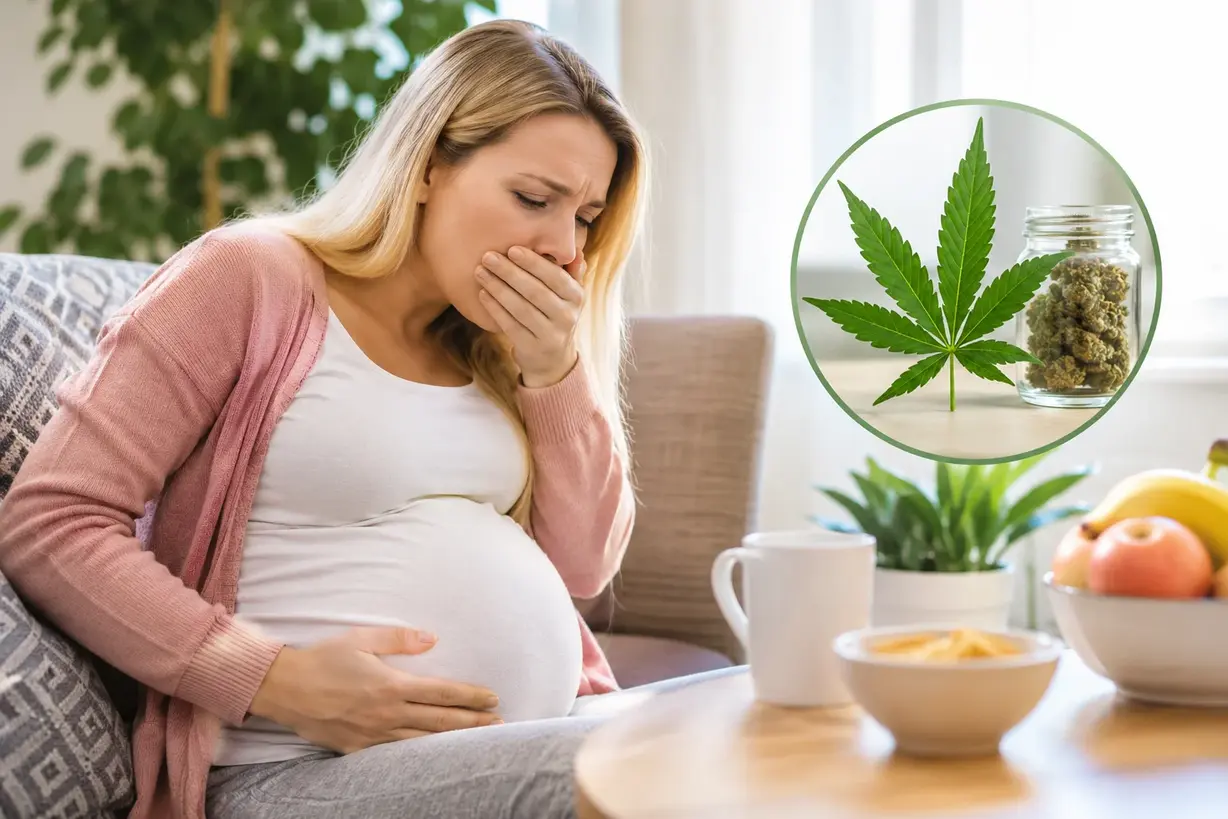
If you have spent early pregnancy feeling queasy from the moment you wake, you will know how draining it is. The NHS describes morning sickness as very common in early pregnancy and notes that, despite the name, it can strike at any time of day, or last all day. So it is understandable that some expecting mums wonder whether cannabis, often talked about as a natural fix for nausea, might take the edge off.
It is a question worth asking out loud rather than quietly. In May 2025, researchers at Oregon Health & Science University published an updated review in JAMA Pediatrics that pooled 51 studies involving 21.1 million people. They found moderate-certainty evidence linking cannabis use in pregnancy to higher odds of low birth weight, preterm birth and babies born small for their gestational age.
This guide is written without judgement. It looks at what the research says, why the topic keeps coming up, and what tends to help instead. And if cannabis has become hard to stop, during pregnancy or at any other time, telling your midwife or doctor is a good first step, and support can include outpatient counselling or luxury substance abuse treatment, depending on what someone needs.
Why Cannabis Keeps Coming Up In Conversations About Nausea

Mums who feel the worst do seem more likely to reach for it. A 2018 research letter in JAMA Internal Medicine, led by Kelly Young-Wolff at Kaiser Permanente Northern California, looked at 220,510 women screened in the first trimester. Among women with severe nausea and vomiting, 11.3% used cannabis during pregnancy, compared with 4.5% of women who had no nausea or vomiting.
Advice from outside the doctor’s surgery has played a part too. In a study published in Obstetrics & Gynecology in 2018, researchers at Denver Health called 400 cannabis dispensaries in Colorado. According to Denver Health, 69% recommended cannabis products to treat nausea in early pregnancy, fewer than a third encouraged the caller to speak to her doctor first, and 65% based their recommendation on personal opinion.
Dr Jamie Lo, the maternal-fetal medicine physician who led the 2025 review, has said that many patients continue using cannabis because it eases common pregnancy symptoms such as nausea, poor sleep and pain. As she put it, “Until direct harms have been proven, they perceive it to be safe to use.”
What The Latest Research Is Telling Us
A Stronger Picture From The 2025 Review
The OHSU team’s update added eight new studies to an earlier review, and the certainty of the evidence rose from very low to low, to moderate, for low birth weight, preterm birth and babies being small for gestational age. The review also reported higher odds of newborn death, although the researchers rated the certainty of that finding as low. The OHSU announcement also points to animal research in which THC exposure in nonhuman primates affected blood flow and oxygen availability in the placenta and reduced amniotic fluid.
Use Is Rising, Even As Other Habits Fall
A study published in Obstetrics & Gynecology in 2024, using health records from a large California healthcare system, found prenatal cannabis use rose from 5.5% in 2012 to 9.0% in 2022. In Canada, a 2025 study in JAMA Network Open covering 975,242 pregnancies in Ontario found cannabis use during pregnancy rose 2.5-fold between 2012 and 2022. Dr Lo has noted that this rise comes as alcohol and nicotine use in pregnancy have declined.
What Health Bodies Advise
The guidance is consistent. The US Centers for Disease Control and Prevention (CDC) explains that the chemicals in cannabis, in particular THC, pass through your system to your baby, and it recommends that pregnant people do not use it.
The American College of Obstetricians and Gynecologists (ACOG) sets out its position in Clinical Consensus No. 10, published in October 2025, which replaced its earlier Committee Opinion No. 722. It says there is no medical indication for cannabis use in pregnancy or after birth, and advises stopping during pregnancy and lactation, including where cannabis has been used for medical reasons.
Gentler Ways To Ease Morning Sickness
There are well-established options to try first. These come from NHS guidance, with medication advice from ACOG:
- Rest when you can: The NHS notes that tiredness can make nausea worse.
- Little and often: Small, frequent meals of plain, starchy, low-fat foods such as bread, rice, crackers or pasta are easier on a queasy stomach.
- Something dry first thing: A slice of dry toast or a plain biscuit before you get up can help settle things.
- Cold over hot: If cooking smells set you off, cold foods may be easier to face.
- Sip, do not gulp: Drinking plenty of fluids in small, regular sips helps you stay hydrated.
- Ginger: Ginger foods or drinks may help, though the NHS advises checking with a pharmacist before taking ginger supplements.
- Wrist acupressure: Some mums try a wristband or gentle finger pressure on the wrist.
- Ask about medicine: If sickness is severe, the NHS says your GP may prescribe a short course of an anti-sickness medicine that is safe in pregnancy, and ACOG’s guidance supports vitamin B6, alone or with doxylamine, as a first-line option.
If these are not enough, that is a reason to go back to your GP or midwife, not a reason to struggle on alone.
When It Is More Than Ordinary Morning Sickness
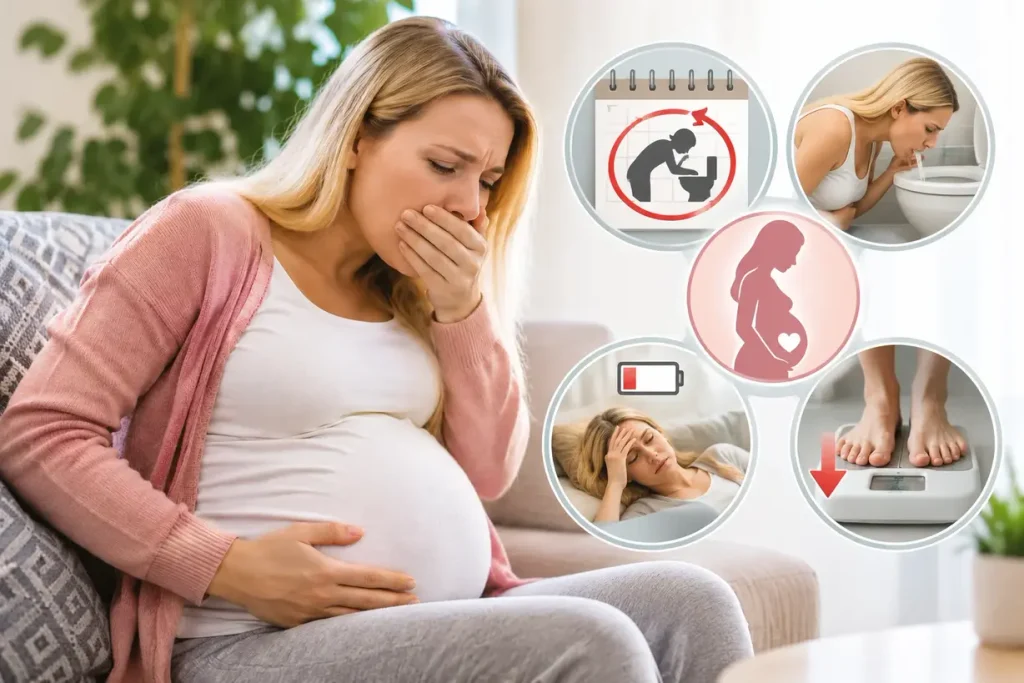
According to the NHS, morning sickness usually clears up by weeks 16 to 20 and does not put your baby at increased risk. For some mums, though, it becomes hyperemesis gravidarum, a severe form that can lead to dehydration and malnutrition and may need specialist treatment, sometimes in hospital.
The NHS advises calling your midwife, GP or 111 if you are vomiting and your wee is very dark or you have not been for more than eight hours, you cannot keep food or fluids down for 24 hours, you feel very weak, dizzy or faint when standing, you have tummy pain or a high temperature, you vomit blood, or you have lost weight.
If Stopping Feels Harder Than Expected
Some mums used cannabis long before pregnancy, and stopping is not always simple. ACOG now advises universal screening for cannabis use before, during and after pregnancy, so your midwife bringing it up is routine, not an accusation. Dr Nancy Goler, senior author of the Kaiser Permanente study, said pregnant women need to be screened and given information about possible negative effects “while also receiving medically recommended treatment options.”
Dr Lo has said that abstinence is ideal but not realistic for many patients, and that “even using less can mitigate the risk.” Being honest means your care team can help with both.
Final Thoughts
Wanting relief from relentless nausea is completely natural, and asking about cannabis does not make anyone a bad mum. The research, though, is getting clearer, and health bodies advise against using it while pregnant or breastfeeding. Rest, small meals, ginger and, where needed, prescribed medicine are safer places to start.
Disclaimer
This article is general information only and is not medical advice. Please speak to your midwife, GP or obstetrician about any symptoms, medicines or substance use during pregnancy.
Frequently Asked Questions (FAQs)
1. Is Cannabis Safe To Use While Breastfeeding?
Health bodies advise against it. The CDC says chemicals from cannabis can pass to a baby through breast milk and encourages breastfeeding parents to avoid all cannabis use, while ACOG says the data on use during lactation are limited and discourages it.
2. How Long Does Morning Sickness Usually Last?
The NHS says it usually clears up by weeks 16 to 20 of pregnancy. If you cannot keep fluids down for 24 hours, feel faint or are losing weight, contact your midwife, GP or 111, as this could be hyperemesis gravidarum.
3. Should I Tell My Midwife If I Used Cannabis Before I Knew I Was Pregnant?
Yes. ACOG advises that everyone is screened for cannabis use around pregnancy, so the question is routine. Sharing it helps your midwife support you properly.