


When you first go through an IVF cycle, there comes a point where you cannot help but wonder what would happen if this does not work. What if all these injections, appointments, scans, and blood test waiting finally lead to nothing? That can be hard for some people to contend with. It’s tempting to think it’s a simple case of trying enough times to make success happen, but let’s be real: not everyone wants to go through the same emotional and physical rollercoaster again. It’s overwhelming, and when success doesn’t happen on the first try, it can feel scary.
This, in turn, naturally leads you to wonder just how many times you should actually try with IVF. While no magic number exists, factors and information from your previous cycle can help you assess whether to make another wholehearted attempt. Before you decide, let’s look at what your previous cycle meant and whether you have alternatives to IVF.
Is There A Recommended Number Of IVF Cycles?
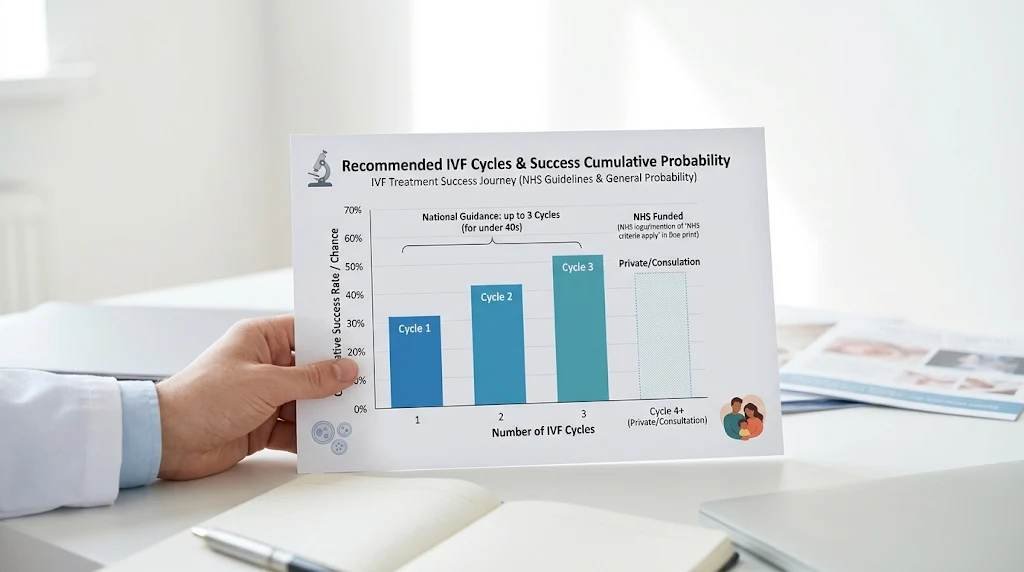
An IVF cycle actually means one egg collection followed by one embryo transfer. In other words, if you have your ovaries stimulated, have eggs collected, and then go through an embryo transfer, you will have completed one full IVF cycle. The NHS overview of IVF explains each of these stages in more detail.
For eligible women, trans men, and non-binary people with female reproductive organs under the age of 40, national guidance recommends going through three full cycles of IVF in specific circumstances. Said circumstances can include a diagnosed cause of infertility where other treatments are unsuitable or have not worked, or having tried to get pregnant through regular unprotected sex for two years without success (or after 12 unsuccessful cycles of artificial insemination).
If you’ve already gone through three unsuccessful cycles, the best course of action would involve discussing the probability of success with a fertility doctor and the implications of going through further treatment. Any cycles beyond the three recommended for people under 40 are unlikely to be NHS-funded, so further treatment usually means going private. But this shouldn’t be interpreted as a rule that everyone needs exactly three cycles, or that three unsuccessful cycles automatically mean you should stop. Your situation and what happened during previous treatment will still affect the course forward.
What Determines Whether Another IVF Cycle Is Worth Considering?
Your age, the cause of infertility, how your ovaries responded to stimulation in the previous cycle, the number of eggs collected, the results of the fertilisation, embryo development, and embryo quality. These are the primary factors that can govern what happens next in your journey. Age is the most important factor because fertility changes over time, affecting the likelihood of producing embryos capable of leading to pregnancy. UK data shows how much IVF birth rates vary with age, with the average birth rate per embryo transferred ranging from 38% among patients aged 18 to 34 to 8% among those aged 43 to 44.
But age alone cannot tell you what will happen in your next IVF cycle. One of the best things about IVF is just how much data it gives your fertility team about your body. If your ovaries, for instance, responded poorly to medication in the previous cycle, the stimulation approach can be tweaked and reconfigured. If you produce plenty of eggs but very few that fertilise, that points toward a different part of the process that can be changed. If the embryos developed but did not lead to a pregnancy, the team can review every aspect of the process and the bigger picture before deciding what to do next.
One unique reason why people also consider another IVF cycle is to give frozen embryos a try. One egg collection in one cycle can produce several embryos, and some good-quality ones can be frozen for later transfers. The point is that even if a single transfer fails, it doesn’t necessarily mean the entire IVF cycle has failed in a broader sense. Frozen embryos available from the same episode of ovarian stimulation can give you more opportunities without having to go through an entire IVF cycle all over again. You can read more about how embryo freezing works on the UK fertility regulator’s website.
When Should You Reconsider Your IVF Treatment Strategy?

Look, if you’ve already been through one unsuccessful cycle, it may be tempting to repeat everything and hope that something goes differently this time around. That’s an understandable reaction, but repeated unsuccessful treatment is also a good time to stop and reassess what to do next.
Again, your fertility team is going to look at all the factors mentioned above and will also consider if anything has really changed since the previous attempt that could affect your treatment. As long as you’re working with a good fertility clinic in London, UK, your team will take a close look at your previous treatment and use the information gathered from it to decide what to do next. That could mean keeping the same approach, adjusting it with a variation such as ICSI (where a single sperm is injected directly into each egg), or considering whether a different treatment like IUI, or a different path altogether, makes more sense for your particular situation. To keep your expectations in check, remember that IVF is not a guaranteed process, and sometimes embryos do not implant or develop into a pregnancy, despite the best possible scenario.
How Can You Decide How Many IVF Cycles To Pursue?
Something you need to remember when answering this question is that IVF is a procedure that takes a major physical toll on your body. There is also an emotional side to repeating a treatment that previously did not work, and it should not be brushed aside. Combined with financial costs, time away from work, travel, medication, appointments, and the impact on relationships, it’s a decision that can feel complicated and needs careful handling. Charities such as Fertility Network UK offer free support lines, groups and information for anyone going through this.
There is also a difference between what’s medically appropriate and what’s available in the UK. IVF funding, unfortunately, isn’t consistent across the country, and eligibility criteria can vary depending on where you live. In England, local integrated care boards get to control who can receive NHS-funded IVF in their area, and the government publishes a breakdown of how many NHS-funded IVF cycles each area offers. If you’re on the private route, you still need to review your earlier results and decide whether another cycle makes sense.
At the end of the day, though, you don’t really need to look at IVF as a fixed number of attempts anyway. Despite everything discussed above, one person may end up with several embryos from a single egg collection, while another may need a second stimulation cycle to obtain more. Someone else may decide that, due to their personal situation, the treatment is no longer right for them.
As such, the best thing that you can do for yourself is to treat every single aspect of your life, the procedure, and the different parts of the procedure as sources of information to be analysed. If you can review what happened, what will change, whether anything will actually change next time, and where your life stands, you’ll be in a much better position to decide whether to continue, adapt, or change your treatment. With a few right calls, you will hopefully be able to walk away from this journey having achieved your desired objectives and goals.
Disclaimer: This article is for general information only and is not medical advice. Always speak to a qualified fertility specialist or your GP about your own situation before making treatment decisions.