


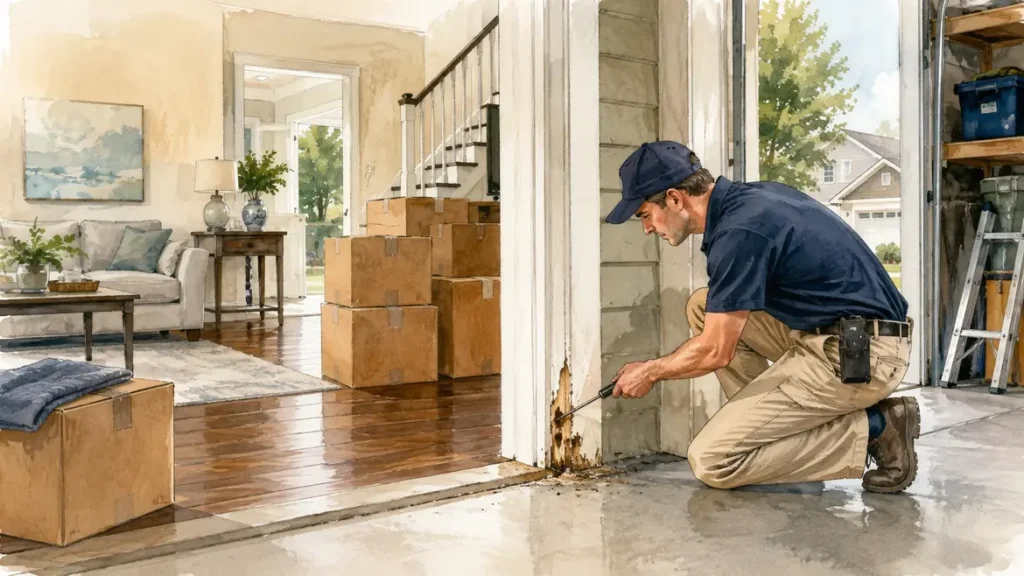
I had already mentally spent the money from the sale when the inspector pushed the tip of a screwdriver into a piece of trim near the garage.
The wood gave way.
Not dramatically. There was no shower of insects and no movie-style moment where half the wall collapsed. A small section simply felt softer than it should have.
I remember staring at it and thinking that the inspector must be mistaken.
We had lived with that wall for years.
I painted near it. Cleaned around it. Moved boxes past it. I knew about one slightly rough patch near the bottom, but I had always thought it was old moisture damage or a piece of trim that needed replacing.
The house looked normal.
That was what made the next sentence so difficult to hear.
He wanted the area checked for wood-destroying insects.
Until that morning, termites belonged in the same category as major roof failures and foundation disasters. They were problems I imagined a homeowner would obviously know about.
I learned very quickly that hidden termite damage does not always announce itself that way.
And when you are selling a home, the difference between I never noticed it and it was never there suddenly matters a great deal.
Middleburg Heights real estate lawyer Phillip J. Henry Homeowners insurance is quite well set to cater to emergency repair costs, for example, from a fire or a burst pipe or even for hurricane damage. Unfortunately, it is not really made to address sustained damages that can occur for an extended period. Gradual home destruction is usually caused by neglect or an insect invasion that wasn’t averted early.
The Sale Had Felt Almost Finished Before the Inspection
By the time we reached the inspection stage, I had already been through the exhausting part of preparing a house for sale.
Rooms had been cleaned more carefully than they had ever been cleaned while we were actually living in them.
Closets had been thinned out.
Small paint marks had been touched up.
Loose handles had been tightened.
I had stood in rooms trying to see them as a stranger would see them.
That process gives you a strange confidence.
After walking through your own home looking for flaws, you begin to believe you have found most of them.
I certainly did.
I knew which cabinet hinge needed adjusting. I knew where the flooring had a tiny scratch. I knew which section of exterior paint would probably need attention within another year.
I thought I understood the condition of the house.
The termite question showed me how limited that understanding really was.
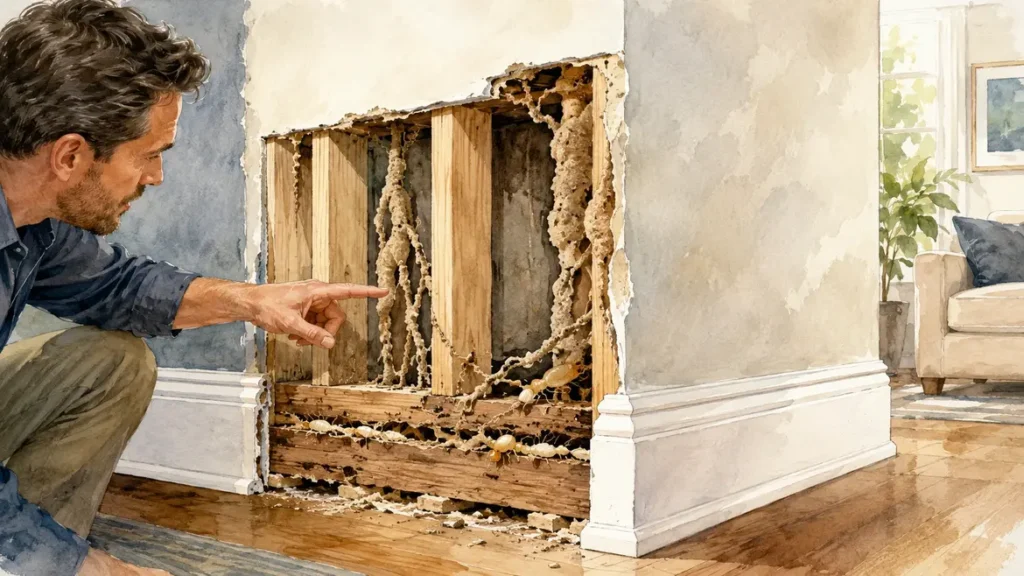
Termites can remain concealed inside wood, walls, floors and other building components. Mississippi State University Extension notes that homeowners sometimes first uncover termite evidence while removing wallpaper, doing repairs or opening parts of a structure that previously looked normal. Its guide to signs of termite infestation also explains that visible damage may represent either current activity or older damage from a previous infestation, which is one reason professional inspection matters.
That distinction became extremely important during our sale.
Finding damaged wood did not automatically tell us whether termites were active.
It only told us that the question could no longer be ignored.
I Had Seen a Warning Sign and Given It a More Convenient Explanation
Looking back, this is the part I feel most uncomfortable admitting.
The rough patch near the trim had not appeared overnight.
I had noticed it before.
It was small enough that I had explained it away.
Perhaps somebody had bumped something into it.
Perhaps old moisture had caused the surface to swell.
Perhaps the previous owners had made a poor repair.
All of those explanations were possible.
I simply preferred them because none required me to investigate further.
The U.S. Environmental Protection Agency’s homeowner guidance on termites explains that termite problems can be associated with conditions such as moisture, cracks, wood near soil and other access points around a structure. EPA recommends periodic inspection, repairing leaks, maintaining drainage and reducing wood-to-soil opportunities as part of termite prevention.
That does not mean every soft board or water stain is caused by termites.
It means appearance alone is not enough to identify the cause.
My mistake was not failing to diagnose termites myself.
I am not a termite inspector.
My mistake was seeing something I did not understand and deciding that the least inconvenient explanation was probably correct.
The Inspector Would Not Tell Me What I Wanted to Hear
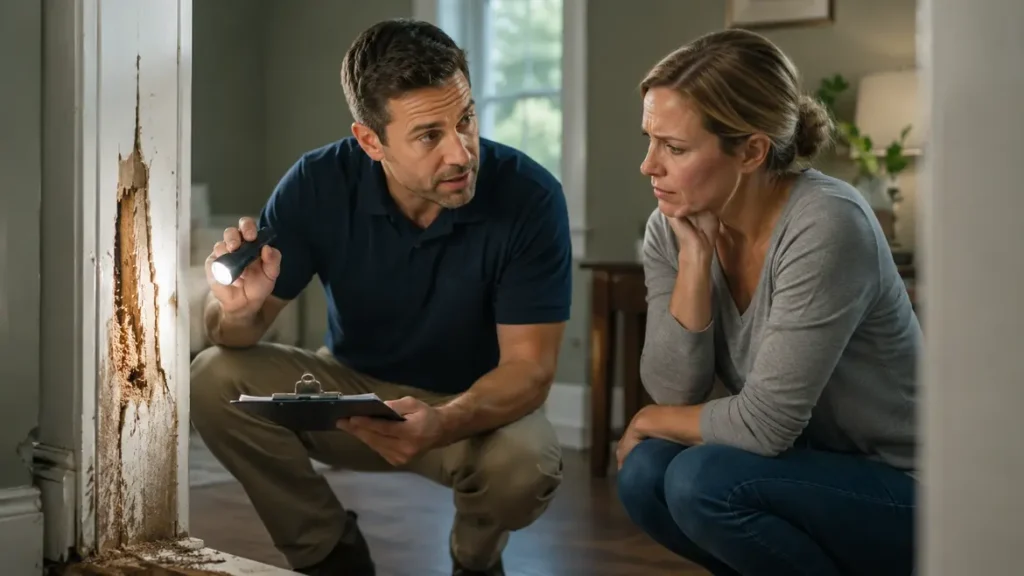
I wanted one simple answer.
“Are there termites?”
Instead, the first careful answer was much more limited.
There appeared to be damage that warranted a wood-destroying-insect inspection.
At the time, that felt frustratingly cautious.
Now I appreciate it.
A normal home inspection and a specialised termite or wood-destroying-insect inspection are not necessarily the same service.
In Texas, for example, the Texas Real Estate Commission states that a person reporting on wood-destroying insects in a home must meet the state’s licensing requirements for that work.
The Texas Department of Agriculture’s termite inspection information is even more useful because it explains what one of these inspections does not guarantee. The inspection covers readily accessible areas and looks for visible evidence, but inspectors are not generally dismantling the building to see every hidden surface. The report therefore is not a warranty that a property contains no wood-destroying insects, and it is not the same thing as a structural engineering report.
That was one of the most useful pieces of information I learned during the entire sale.
There are different questions:
Is there visible evidence of termites or another wood-destroying insect?
Does the evidence look current or historical?
How extensive is the physical damage?
Is structural repair necessary?
What treatment, if any, is appropriate?
One person may not be qualified to answer all of them.
The Word “Damage” Scared Me More Than the Actual Report
Before the specialist arrived, my imagination became expensive.
I pictured walls being removed.
Framing being replaced.
The buyer walking away.
The sale starting over.
I searched repair costs before I even knew what required repair.
That was a mistake.
When the wood-destroying-insect inspection happened, I tried to listen to the wording rather than mentally jumping to the worst possible outcome.
Evidence of termite damage is not automatically evidence that a house is structurally unsafe.
The official Texas Wood Destroying Insect Report makes this distinction very clearly. The state’s form warns that a wood-destroying-insect inspection is not a structural-damage report and says evaluation of structural damage and corrective work should be performed by someone properly qualified for that job.
That sentence saved me from mixing two different problems together.
Termite treatment addresses the insect issue.
Carpentry or structural repair addresses damaged building material.
Sometimes both are needed.
Sometimes the damage is limited.
The inspection has to come before the conclusion.
Hidden Did Not Mean Undetectable
Once someone showed me what to look for, I became annoyed with myself because several clues seemed much easier to understand.
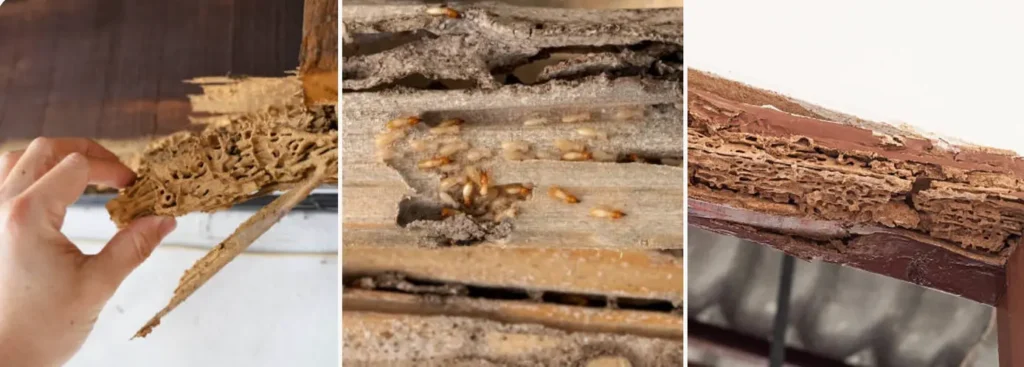
Termite-damaged wood may be hollowed internally, sometimes with soil or dried mud in galleries. Subterranean termites can also build shelter tubes as protected routes between soil and wood.
The University of Kentucky’s homeowner termite-control guidance describes these internal galleries and mud-lined areas as characteristic evidence that can help distinguish termite damage from some other types of wood deterioration.
The EPA also lists swelling, warped areas and damage that can resemble moisture problems among things that may justify closer investigation.
The important word is may.
I would never look at a swollen baseboard now and announce that a home has termites.
I would recognise that something has changed and deserves a proper explanation.
That is a very different mindset.
Homeownership became less stressful for me once I stopped believing I was supposed to know the answer myself.
I only needed to recognise when the question had become too important to ignore.
The Sale Turned a Home Problem Into a Documentation Problem
If I had found the damage while we planned to stay in the home for another decade, the process would still have involved inspection, treatment and repair.
Selling added another layer.
Documentation.
The buyer wanted to understand what had been found.
We needed a clear report.
If treatment was recommended, we needed paperwork showing what had been done.
If damaged material was repaired, invoices and photographs became useful.
The more organised that file became, the less frightening the issue felt.
That connected unexpectedly with something I had written about in FsiBlog’s home organisation advice. Normally I think of home organisation in terms of reducing clutter and making everyday life easier. A home sale showed me another side of it.
Records are part of an organised home too.
Invoices.
Warranties.
Inspection reports.
Treatment paperwork.
Major repair receipts.
Dates.
Contractor details.
I had kept some of those things carefully and others much less carefully.
I would handle that differently now.
Disclosure Was the Part I Refused to Guess About
The moment we knew there was termite-related information, another question appeared.
What exactly did we need to disclose?
This is where I became very cautious because seller-disclosure requirements are legal matters and vary by jurisdiction.
I did not want a blog, a neighbor, an online forum or even another person’s previous home sale to become my legal advice.
I wanted the actual rule that applied to the property.
Texas provides a useful example of why sellers should check their own state requirements carefully. The Texas Real Estate Commission’s current Seller’s Disclosure Notice includes property-condition information required under state law.
Texas law specifically includes questions relating to active termites or other wood-destroying insects, termite or wood-rot damage needing repair, previous termite damage and previous termite treatment.
A different state may have different wording, forms, exceptions or requirements.
So the lesson I kept was not “this is what every seller must disclose.”
It was much simpler:
Once I know something material about a home’s condition, I should not make legal assumptions about whether I can leave it out.
That is when I use the appropriate disclosure form and, if necessary, obtain advice from a qualified local real-estate professional or attorney.
I Stopped Thinking of Disclosure as Confessing a Defect
Emotionally, disclosure felt uncomfortable at first.
I had spent weeks trying to present the house at its best.
Suddenly I was documenting a problem.
Those goals felt contradictory until I realised they were not.
A home can be attractive, well cared for and still have a history.
In fact, almost every older house has one.
Roofs have been repaired.
Pipes have leaked.
Appliances have failed.
Wood has been replaced.
Pests have been treated.
The issue is not whether a home has ever required work.
The issue is whether buyers can understand what they are actually buying.
That changed my attitude toward the termite paperwork.
The report was not a stain on the property.
It was information.
Treatment records were not something I wanted to hide.
They demonstrated that the issue had been addressed.
Repair documentation helped separate a known, handled problem from an unexplained one.
The Buyer Asked the Question I Would Have Asked Too
The buyer wanted to know whether the termites were still active.
At first, the question made me defensive.
We were paying to deal with the issue. Why wasn’t that enough?
Then I switched sides mentally.
If I were buying the house, I would ask exactly the same thing.
I would also want to know where the evidence had been found.
What had been treated.
Whether damaged wood had been assessed.
Whether there was a warranty.
Whether moisture or another condition had contributed.
Whether the treatment company would transfer any coverage to a new owner.
That moment changed the tone of the negotiation for me.
I stopped hearing questions as accusations.
The buyer was trying to reduce uncertainty.
So were we.
That is when I wrote 1.Anchor across the top of my folder: the goal was not to make the termite history disappear, but to make the uncertainty smaller.
Everything became easier to evaluate after that.
One Estimate Was Not Enough for Me
When treatment entered the conversation, I learned how different termite proposals can sound.
One company might recommend a particular soil treatment.
Another might discuss bait stations.
Another may focus on a combination of approaches depending on termite type, building construction and evidence found.
The EPA’s termite guidance explains that registered termite-control approaches include liquid soil-applied termiticides, termite baits, building-material treatments and other products, with the appropriate method depending on the situation.
That is why I became uncomfortable with any company that acted as though there was only one possible product before properly inspecting the property.
I wanted to know what evidence they found.
Which termite or wood-destroying organism they believed was involved.
What areas would be treated.
What pesticide or bait system would be used.
Whether retreatment or monitoring was included.
What the warranty actually covered.
And, importantly, what was not included.
The National Pest Management Association’s information about the NPMA-33 wood-destroying-insect report also helped me understand why lenders, inspectors and pest professionals sometimes refer to specialised WDI paperwork during real-estate transactions.
The cheapest initial number did not automatically tell me which proposal offered the best value.
The scope mattered more.
Treatment and Repair Were Two Separate Bills
This was another surprise.
In my mind, termite company equals termite problem solved.
Not necessarily.
Pest professionals can address infestation and prevention within the scope of their licenses and services.
They may not be the people qualified to determine whether a damaged beam, stud, joist or other building component remains structurally sound.
The official Texas WDI report explicitly says the pest-control inspection is not a structural-damage assessment.
That meant I needed to keep the work streams separate.
First, understand the insect evidence.
Second, address active infestation when found.
Third, understand the physical condition of the damaged material.
Fourth, repair what actually needs repairing.
That order helped us avoid two opposite mistakes.
The first would have been treating the termites and assuming every damaged piece of wood was fine.
The second would have been ripping out large sections of the house before anyone had determined whether that level of repair was necessary.
The FHA Question Taught Me That Financing Can Affect the Conversation
I had thought the termite issue was simply between seller and buyer.
Financing can add another party with its own requirements.
HUD’s guidance for FHA-insured transactions explains that a wood-destroying-insect inspection is not automatically required for every property, but may be required when there is evidence of active infestation, when local rules require it, when it is customary for the area or when the lender requires it.
That was useful because I had heard people make sweeping claims in both directions.
“FHA always requires a termite inspection.”
“Termites have nothing to do with the lender.”
Neither generalisation was useful enough.
The actual transaction, property, visible evidence, local requirements and loan conditions matter.
That became a recurring theme throughout the sale.
Real estate punishes vague assumptions.
The Damage Also Changed How I Thought About Cheap Cosmetic Repairs
Before selling, I had planned to replace the damaged-looking trim myself.
A short board.
Some paint.
Done.
I am now very glad I did not simply cover it.
A cosmetic repair can make a surface look better without explaining why it deteriorated.
That does not mean every damaged trim board needs a pest investigation.
Wood can deteriorate because of moisture, impact, age, poor installation and plenty of other causes.
But if the cause is uncertain, covering the evidence before understanding it can create a much bigger problem later.
This lesson changed how I think about the advice in FsiBlog’s home improvement ideas that avoid costly renovations.
Small improvements are wonderful when the problem is cosmetic.
Paint is excellent at fixing ugly paint.
It is terrible at diagnosing what is happening behind a wall.
Moisture Became Part of the Conversation Even Though It Wasn’t the Whole Answer
Termite conversations quickly led back to moisture.
Subterranean termites need moisture and commonly maintain connections with soil, although building conditions can create complicated situations.
EPA recommends fixing leaks, maintaining proper drainage around foundations, keeping gutters and downspouts functioning and reducing conditions that make structures attractive or accessible to termites.
I started looking differently at areas around the house.
Was irrigation keeping soil beside the structure wetter than necessary?
Was water draining away correctly?
Were there wood materials stored where they should not be?
Was vegetation making inspection difficult?
Had any small plumbing leak been treated as only a plumbing issue?
None of these questions proves termites are present.
They are maintenance questions.
That distinction matters because after finding one problem, I became temporarily capable of seeing termites everywhere.
Every crack became suspicious.
Every old board looked dangerous.
That is not useful either.
Good maintenance reduces risk.
Anxiety does not.
I Learned Why “No Visible Termites” Is Not the Same as “No Termites”
This was one of the technically important lessons.
Termites live in concealed environments.
A visual inspection has limits.
Mississippi State University’s termite guidance shows examples where activity remained hidden behind siding, wallpaper and building materials until those areas were opened.
Texas’s regulatory guidance similarly states that WDI inspections focus on areas that are readily accessible and normally do not involve dismantling parts of the building.
That means a clean inspection report is valuable, but I no longer interpret it as a magical certificate guaranteeing that no termite could possibly exist anywhere inside a property.
I read scope and limitations.
That is a habit I wish I had learned much earlier with every type of home report.
Inspection reports tell me what was inspected, what was observed and what limitations existed.
The fine print is not filler.
The Buyer Did Not Walk Away
This is the point where many home-sale stories would try to create suspense.
Will the deal collapse?
Will everything be ruined?
Ours became much less dramatic once there was reliable information.
The pest inspection clarified the concern.
The treatment question became manageable.
The damaged area could be evaluated properly.
Documentation could be provided.
The buyer could decide with better information.
That does not mean every termite discovery ends the same way.
A different home may have more extensive damage.
A buyer may negotiate differently.
A lender may impose requirements.
Treatment costs vary.
Repair costs vary even more because structural damage depends on location and severity.
What I learned is that uncertainty was causing more panic than the confirmed facts.
Once professionals put boundaries around the problem, we could make decisions.
I Would Never Promise a Buyer “It’s Completely Gone Forever”
I understand why a seller wants to say this.
We treated it.
Problem solved.
But termites are not a product defect that can be replaced once and guaranteed never to return.
Treatments have specific scopes and warranties.
Homes continue to need inspection and maintenance.
The EPA recommends periodic inspection even after construction and emphasizes maintaining drainage, repairing leaks and reducing conditions that can invite termite activity.
I would rather give a buyer the treatment record and warranty terms than make a promise I cannot prove.
Documentation is stronger than reassurance.
The Repair Folder Became Part of the House
By the end of the process, I thought of the paperwork almost like another appliance being transferred with the property.
The folder contained the things I would have wanted as a buyer.
Inspection information.
Treatment records.
Repair invoices.
Relevant warranties.
Dates.
Contact details for companies that had performed work.
I wish I had maintained that type of house history from the day we moved in.
For future homes, I will.
FsiBlog’s simple DIY home-project advice focuses on making a home more functional through manageable improvements. I would add one invisible home project to that list now: keep better records of what you change and why.
A receipt may feel unimportant when the repair is finished.
During a sale, it can answer a question you have forgotten anyone would ever ask.
What I Would Do Before Listing Another Home
I would not tear open walls looking for termites.
I would not pay for every specialist inspection imaginable just because something could theoretically be wrong.
I would do something much calmer.
I would walk around the property with fewer cosmetic intentions.
Instead of asking only, “What should I paint before listing?” I would ask, “What has changed here that I never fully explained?”
Soft wood.
Persistent moisture.
A recurring stain.
An area I repaired twice.
Old pest-treatment paperwork I never read carefully.
An exterior section hidden behind stored materials.
A damaged door frame.
A questionable piece of siding.
Most of those things may have ordinary explanations.
The point is not to diagnose them myself.
The point is to stop assuming that preparing a house for sale means making every suspicious thing look prettier.
Sometimes preparing a house means understanding it.
I Would Also Check the Professional, Not Just the Company Name
Before this sale, if a business had a professional website and many reviews, I probably would have assumed everything necessary was covered.
Now I check the actual qualification required for the service.
Texas, for example, regulates structural pest-control activities through the Texas Department of Agriculture, including termite-control and wood-destroying-insect inspection work. The department’s structural pest-control licensing information explains the categories of regulated work.
Other states have their own systems.
The lesson transfers.
When a report may affect a major real-estate transaction, I want to know who is qualified to produce it.
Hidden Termite Damage Changed the Way I See “As Is”
Before selling, I thought an as-is clause or as-is sale meant the seller simply handed the house over with all its imperfections.
Real life is more nuanced.
Contract language and seller-disclosure obligations are not necessarily the same thing.
A decision to sell without making a repair does not automatically mean a seller can ignore known information that applicable law requires them to disclose.
Because this is jurisdiction-specific legal territory, I would always use the correct local forms and obtain professional advice rather than relying on somebody else’s transaction.
That is especially true with termites because the issue can involve current activity, previous activity, prior treatment, repair status and structural questions.
One word such as “treated” does not necessarily explain all of that.
The Termites Were Not the Biggest Lesson
By closing day, the damaged trim no longer felt like the centre of the story.
The real lesson was how much homeownership depends on knowing the limits of what I can see.
A house can look beautiful and still have a problem behind a finished surface.
A rough board can look frightening and turn out to be manageable.
A termite report can identify wood-destroying-insect evidence without telling me whether a structural member needs replacement.
A treatment can address an infestation without erasing the house’s history.
A disclosure can make a buyer nervous and still be far better than giving them a surprise later.
The sale forced me to separate appearance from condition.
I wish I had learned that before there was a buyer waiting for answers.
I No Longer Think the Best-Maintained Home Is the One With No Problems
That idea has probably changed most of all.
Houses have problems.
Even carefully maintained ones.
Things wear.
Water finds places it should not.
Pests find tiny paths.
Materials age.
Owners miss things.
The standard I now care about is different.
When something changes, do I pay attention?
When I do not understand the cause, do I investigate before covering it?
When specialised knowledge is needed, do I use the right professional?
Do I keep the report?
Do I fix contributing conditions as well as visible symptoms?
And when someone else is considering buying the property, do I give them the information they are entitled to receive?
That is a much more realistic definition of taking care of a home.
The inspector’s screwdriver left a tiny hole in that old piece of trim.
At the time, I hated seeing it.
It represented cost, delay, uncertainty and a problem I had never planned to discuss during the sale.
Now I remember it differently.
The hole was not what damaged the house.
It simply revealed that a surface I had trusted was hiding a story underneath.
Selling the home taught me that those stories matter.
Not because every hidden defect is catastrophic.
Because the moment I know it exists, I can stop guessing and start dealing with what is actually there.