


Executive travel often looks efficient on a calendar while hiding hours of unproductive time between scheduled commitments. A 60-minute client meeting can consume half a day once baggage handling, terminal transfers, traffic delays and early check-in requirements enter the equation.
These problems affect more than individual productivity. They can raise travel costs, delay decisions and leave senior employees arriving at important meetings tired or distracted. Reports on peak-season lost time show how easily disruption can spread across executive schedules.
Companies can reduce that friction by treating the time between appointments as part of the business itinerary. That means planning where bags will go, how teams will move through transport hubs and what flexibility is available when a meeting ends earlier than expected.
Lost Hours Between Client Meetings
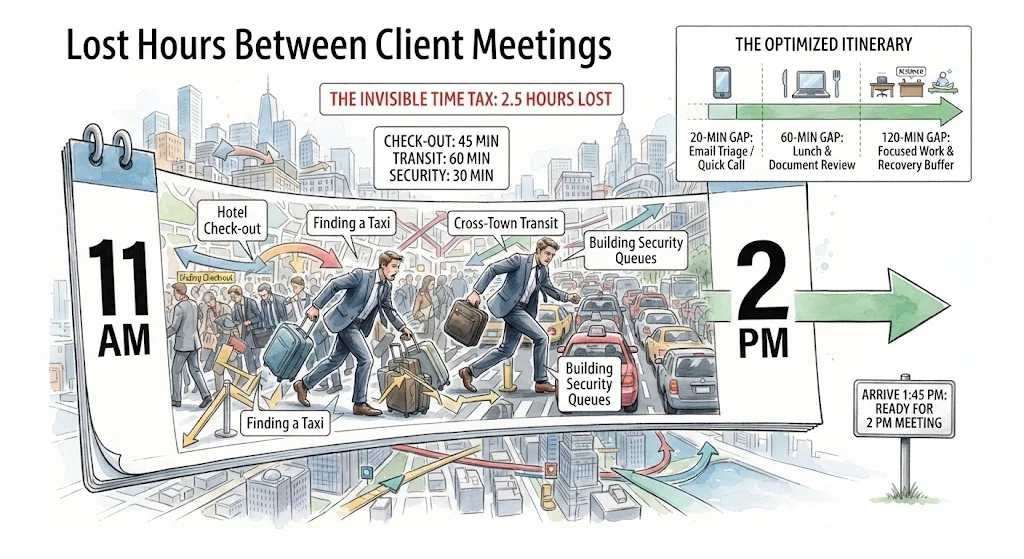
The biggest gaps in an executive itinerary aren’t always visible. A calendar might show a meeting ending at 11 a.m. and another beginning at 2 p.m., suggesting three available hours. In practice, checking out of a hotel, moving bags and finding a suitable place to work can consume most of that window.
Start by building a door-to-door schedule. Record the time needed to leave the meeting venue, reach the next district and pass through any building security. Include a realistic margin for traffic or transit disruption. An executive with a 2 p.m. appointment should know when to leave by 1:15 p.m., not simply where the meeting begins.
Travel managers can also label open periods according to their practical value:
- A 20-minute gap may support email triage or a short internal call
- A 60-minute gap may allow document review and lunch
- A two-hour window may be suitable for focused work or an extra local meeting
Reliable connectivity and access to a quiet workspace matter during longer gaps. Hotel business areas, coworking day passes and reserved meeting rooms can all turn waiting time into usable time. Well-designed business travel technology can also bring itinerary changes, booking details and policy guidance into one place, reducing the time employees spend searching through messages.
Keep the schedule selective. Filling every open slot creates a plan that collapses after one delayed train. Preserve at least one recovery window each day so the traveler can absorb disruption without moving every later commitment.
Navigating Crowded Rail Terminals
Major rail terminals concentrate several sources of delay in one place. Travelers may need to find the correct entrance, read unfamiliar departure boards, locate a platform and move through crowded corridors while carrying luggage. During busy periods, even buying coffee or reaching a taxi line can take longer than expected.
Plan the terminal portion as a separate stage of the trip. Save digital tickets in advance, record the service number and confirm which exit is closest to the next meeting. Where possible, choose a clear meeting point outside the busiest concourse. “Main entrance” may sound precise, but a large station can have several street-level entrances spread across different blocks.
Baggage deserves its own plan, especially when hotel checkout comes hours before an evening departure. Travelers passing through Sydney may search is there luggage storage at Sydney central station when they need to book a local storage location and move around the city without carrying their bags. The practical benefit is straightforward: a traveler can attend a meeting, have lunch with a client or work nearby before collecting luggage for the next connection.
Confirm storage hours and collection times before booking. Leave enough time to retrieve each item and reach the platform without rushing. The same rule applies to any station service used during a business trip.
A simple terminal note in the itinerary can prevent confusion. Include the station address, expected arrival time, entrance or exit, luggage plan and onward transport. Keep this information available offline in case mobile coverage drops inside the building.
Decentralized Drop Points for Busy Teams
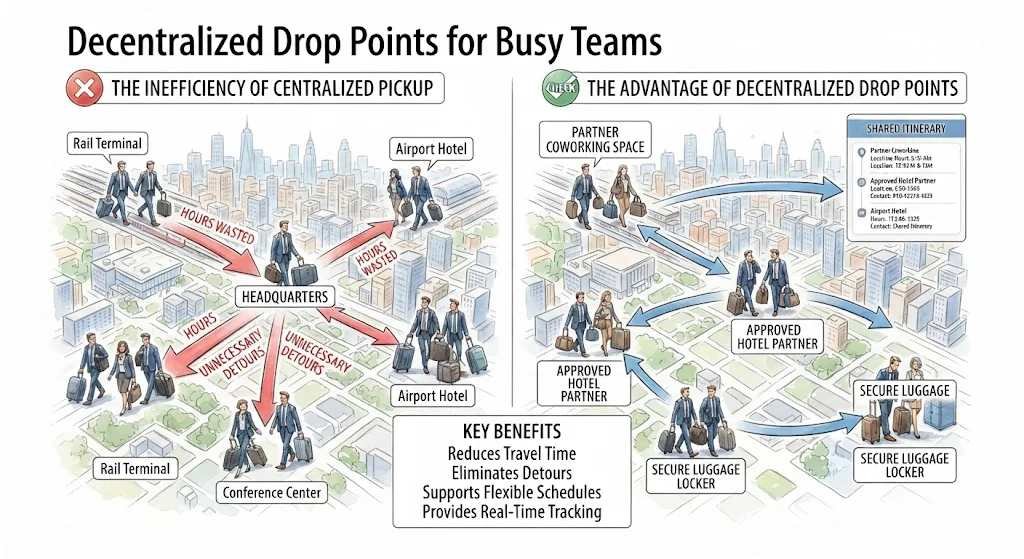
Group travel creates a different problem. If six employees all need to return to one hotel, office or central facility before departing, the shared pickup point can add hours across the team. It can also force people traveling in opposite directions to converge unnecessarily.
Decentralized drop points give travelers options near the places where they already have meetings. These may include approved luggage locations, coworking spaces with reception services or hotels that have agreed to support an event. The arrangement works particularly well during conferences, leadership retreats and multi-site client visits.
Consider a team attending meetings across three business districts. Two employees finish near the rail terminal, two remain near the conference venue and two travel directly to the airport area. Sending everyone back to headquarters could create six extra trips. Assigning suitable collection points near each person’s final appointment removes that detour and gives the travel manager a clearer view of departure times.
Good coordination still matters. The team needs a shared itinerary that lists each location, operating hours, booking reference and responsible contact. A platform built around simplified business travel can help centralize those details and reduce the number of calls to an administrator.
Set boundaries as well. Approved drop points should sit near planned routes, have clear hours and support the type of item being left. Travelers should never rely on an informal arrangement that has not been confirmed. For larger teams, designate one coordinator to verify that all items have been collected before the final departures begin.
This model also gives employees more control over the end of their day. Someone whose final meeting ends early can continue to the station, while a colleague handling a longer client discussion can follow later without holding up the entire group.
Measuring the Return on Fluid Schedules
Flexible schedules need measurable business outcomes. Without basic tracking, a company may see travel planning as an administrative issue even when small delays affect billable work, client relationships, and employee energy.
Begin with time. Compare scheduled travel time with the actual door-to-door duration, then record avoidable detours such as returning to a hotel solely to collect luggage. If 20 monthly travelers each recover 90 minutes, the company gains 30 working hours. Assigning an internal hourly cost makes the value easier to discuss with finance teams.
Track direct expenses alongside time. Useful figures include same-day booking changes, missed connections, extra car trips and unused room reservations. A fluid itinerary may carry a small upfront cost for storage or workspace access while preventing a much larger rebooking charge later.
Employee feedback adds context that expense data can’t provide. Ask travelers which parts of the itinerary caused uncertainty and whether they had enough time to prepare for meetings. Keep the survey short enough to complete on a phone within two minutes. Repeated complaints about a particular terminal or transfer point signal a process problem, not an isolated inconvenience.
Meeting outcomes deserve attention too. The value of business meetings often extends into relationship building, team performance and commercial activity. Travel planning should protect those outcomes by helping people arrive prepared and on time.
Review the results every quarter and look for patterns by route, city and trip type. A schedule designed for a one-day sales visit may need tighter transfer controls, while a three-day conference may benefit more from distributed workspaces and drop points. Use those findings to create preferred itinerary templates while leaving room for local adjustments.
The most useful executive schedule accounts for what happens after one meeting ends and before the next begins. Once those intervals have named locations, realistic transfer times and clear baggage arrangements, they stop being hidden gaps and become manageable parts of the working day.