


My Savannah childhood lives in small things. The creak of a porch swing. The smell of rain hitting hot pavement in July. A spiral notebook balanced on my knees while thunder rolled in from the marsh. I did not know back then that my Savannah childhood and its slow afternoons were teaching me anything. Now, raising Bentley and Harley in Austin, I catch myself handing those same lessons to them almost without trying.
This is not a post about the perfect Southern upbringing. It was ordinary and a little messy, the way most childhoods are. But the more I parent, the more I see how much of my Savannah childhood shaped the mother I am today.
The Porch Was Our Living Room
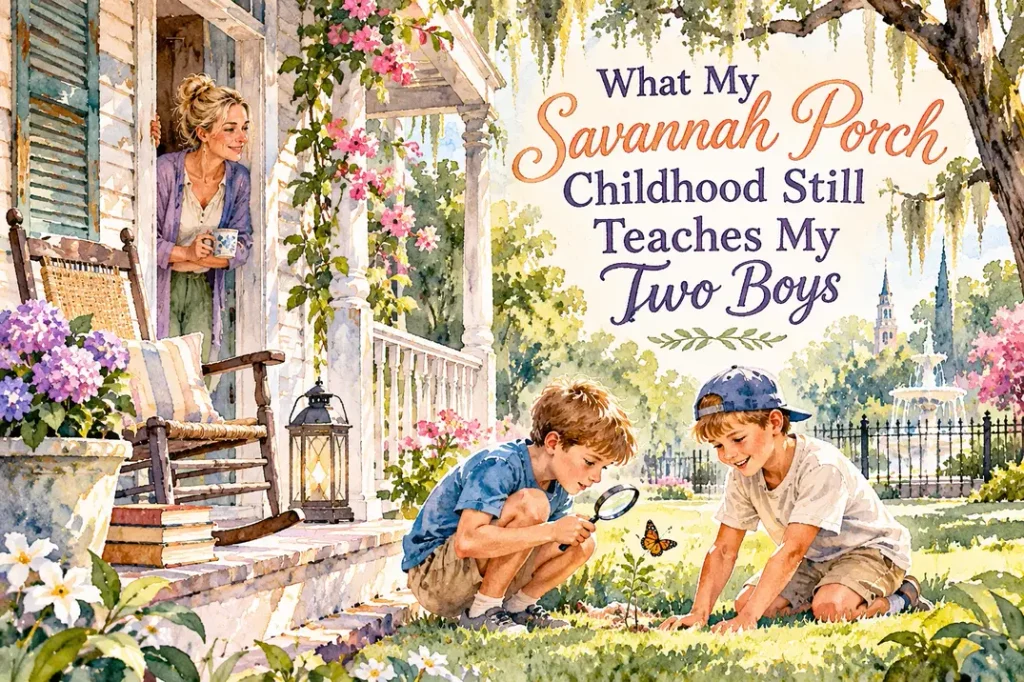
I was born in 1993 at a small hospital in Savannah, and I lived there until I was 13. In our house, the front porch was where life actually happened. Neighbors stopped to talk. Grown-ups shelled peas and argued about the weather. Kids sat on the steps and listened to conversations they were not supposed to understand.
That porch, more than anything in my Savannah childhood, taught me to pay attention. When nobody is staring at a screen, you notice how people talk, what they leave out, and how a story changes each time it gets told. I think that is where the writer in me started.
The city itself shaped my Savannah childhood too. The old streets, the shaded squares, the houses with their tall windows all felt like they were holding secrets. Years later I learned that the city’s core is protected as a National Historic Landmark District recognized for its preserved city plan, which explains why walking those blocks always felt like stepping into another century.
What I Do With the Boys Now
We do not have a deep Southern porch in Austin, but we have a patio and two chairs that wobble. Some evenings I take my coffee out there and wait. Bentley usually arrives first, full of questions. Harley drifts out later and sits close without saying much. Nobody plans it. That is the point.
If you want to build something similar, it helps to create an outdoor space where the whole family actually wants to gather. It does not need to be fancy. It needs a place to sit and a reason to stay.
Summer Storms Taught Me Patience
Anyone who grew up on the Georgia coast knows the afternoon storm. The sky turns a strange green, the air goes still, and then the rain comes down so hard you cannot see the street. As a kid, I hated being stuck inside. My mother would hand me a notebook and say, “Write it down until it passes.”
So I did. I wrote about the lightning, about our neighbor’s dog hiding under the steps, about what I would do when I was grown. Those storms taught me, early in my Savannah childhood, that waiting does not have to be wasted time. Something good can come out of being stuck.
Turning Waiting Into Something Useful
When the boys get restless on rainy days, I try to remember that lesson. Instead of rushing to fill the hour, I offer something simple:
- A blank notebook and a pencil for drawing the storm
- A blanket fort near the window so they can watch the rain
- A story where they get to choose what happens next
- A quiet card game while we listen for the thunder to move away
It does not always work. Bentley sometimes turns the blanket fort into a wrestling ring. But more often than not, the storm becomes part of the fun instead of an obstacle.
Boredom Was a Gift I Did Not Recognize
The biggest lesson from my Savannah childhood is one I am still learning to trust as a parent. I was bored a lot. Long summer days in my Savannah childhood stretched out with nothing scheduled. I filled them by making up games, reading library books twice, and filling notebook after notebook with stories nobody would ever read.
Pediatricians actually back this up. The American Academy of Pediatrics explains that play helps children plan, organize, get along with others and handle stress, and that a little boredom leaves room for creativity. Reading that felt like permission to stop overbooking my kids.
Letting the Boys Lead Their Own Play
It is tempting to fill every free hour with classes and activities. I have done it. But I noticed both boys were more cranky, not less, when every afternoon had a plan. So we started protecting open time.
Child development experts describe unstructured play as time when children decide what to play and how to play it. In our house, that looks like a box of random craft supplies, a backyard, and me resisting the urge to step in.
Bentley builds obstacle courses. Harley lines up his toys and tells them long stories. Neither of those things would happen if I scheduled every minute.
Notebooks, Stories, and Saying Things Out Loud
I kept notebooks through my entire Savannah childhood. Some were diaries. Some were bad poems. A few were lists of places I wanted to see, with New York written at the top in big letters. I told my mother I would live there one day. She did not believe me. I proved her wrong, but that is a story for another post.
What matters here is that writing, a habit my Savannah childhood gave me, offered a place to put big feelings. It helped me understand myself before I had the words to explain it to anyone else.
Giving My Sons a Place for Their Feelings
Neither of my boys is a natural journal keeper, so I adapted. We have a family notebook on the kitchen counter. Anyone can write or draw in it. Sometimes it is a grocery list. Sometimes it is a drawing of a shark. Once, Harley left a note that just said, “I was sad at lunch.” That one tiny line opened a whole conversation I would have missed otherwise.
Here is how we keep it going:
- The notebook stays in one spot so everyone knows where it is
- No one corrects spelling or grammar inside it
- Drawings count just as much as words
- We read a few pages together on Sunday nights
Slow Evenings and Simple Food
Dinner in my Savannah childhood was not complicated. It was rice, vegetables from the market, maybe a pot of beans that had been going all afternoon. What made it special was that we sat together and nobody rushed off.
I cook mostly vegetarian meals now, which would have surprised a few relatives back home. But the rhythm is the same. We eat at the table. Phones stay in another room. Each person shares one good thing and one hard thing from their day.
Those dinners are how I try to keep our family memories from fading as the boys grow. The meal itself is rarely memorable. The conversation usually is.
What My Savannah Childhood Did Not Teach Me
I want to be honest here. Not every part of growing up was a lesson worth repeating. There were hard seasons and moments when I felt invisible. Some of what I learned, I have had to unlearn.
For example, I grew up thinking you did not talk about problems. You smiled and kept going. I do not want that for my sons. So while I keep the porch talks and the storm notebooks, I let go of the silence. In our home, we name hard feelings out loud, even when it is uncomfortable.
Keeping the Good, Changing the Rest
I think this is what every parent does, and I am doing it with my Savannah childhood right now. We sort through our own childhood like a box in the attic. Some things we keep, some we donate, and some we throw out without looking back. My Savannah childhood gave me curiosity, patience, and a love of stories. It also gave me a few habits I am glad to leave behind.
Bringing a Little Savannah Into Austin
Austin is not Savannah. The heat is drier, the storms are different, and there are far more food trucks. But I have found small ways to bring the feeling of my Savannah childhood into our life here:
- We walk to the same neighborhood spot most evenings and say hello to the same people
- We sit outside after dinner, even if it is only for ten minutes
- We let rainy days be slow days
- We tell family stories at bedtime, including the funny ones about my mother
- We keep at least one afternoon a week completely unplanned
None of this requires money or a special house. It just requires a choice to slow down.
Frequently Asked Questions
How can I share my own childhood with my kids without lecturing?
Tell stories instead of rules. Kids remember a funny or surprising story far longer than a lesson. Let them ask questions and follow where their curiosity goes.
Is it really okay to let kids be bored?
In most cases, yes. Short stretches of boredom often lead to creative play. Keep basic supplies nearby and resist the urge to fill every quiet moment for them.
What if I do not have a porch or yard?
Any shared spot works. A balcony, a kitchen counter, or two chairs by a window can become your version of the porch. What matters is that it is consistent and screen free.
How do I start a family notebook?
Buy a simple notebook, leave it somewhere everyone passes, and write the first entry yourself. Keep it judgment free so the kids feel safe adding to it.
My Savannah childhood was not perfect, but it was full of slow moments that turned out to matter. If I can give Bentley and Harley even a handful of those, I will feel like I have passed on the best of where I came from.