


For Australian families expecting babies in October, November, or December 2026, the bedside cot decision carries a summer-specific dimension that other months do not. A bedside cot purchased in October will be in active nightly use during January and February — the hottest months of the Australian year — when the thermal management of the bedside sleep environment becomes as practically important as the proximity benefit that the bedside configuration provides. This October guide addresses both the fundamental bedside cot specifications and the summer-specific considerations that make the Q4 2026 Australian bedside cot decision distinct from the same decision made at other times of year.
Summer Australian Bedside Cot: What Changes
How does the Australian summer specifically affect the bedside cot setup?
Three summer-specific considerations affect the Australian bedside cot setup for Q4 2026 births. First, the mesh or open-side construction: a bedside cot with mesh or open-weave sides provides significantly better airflow around the sleeping Australian summer baby than a fully enclosed bassinet-style product — an important thermal management specification for the January-February peak heat months when the baby is two to four months old. Second, the height-matching measurement: the bedside cot must match the adult mattress surface height with no gap between the two sleep surfaces — this measurement must account for the adult bed configuration as it will be used in summer, when lighter bedding may slightly change the effective mattress surface height compared to the winter configuration. Third, the bedside cot’s room positioning: with two adults and an infant in the Australian master bedroom during the hottest nights, the ceiling fan positioning that manages all three people’s thermal comfort simultaneously requires the bedside cot to be positioned within the fan’s effective airflow range without creating a direct draught on the infant.
Height-Matching Requirement: Australia’s Most Critical Bedside Cot Specification
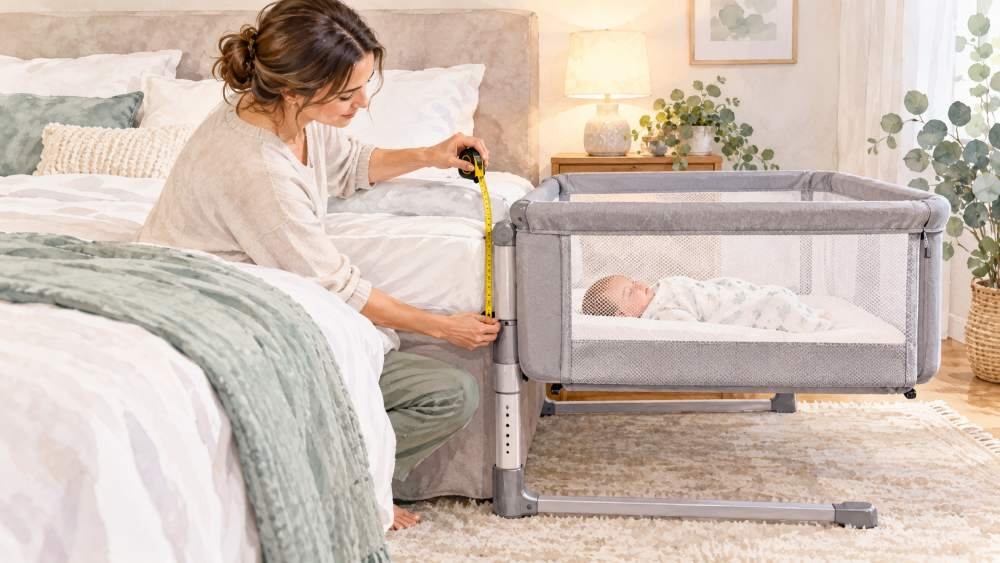
How do Australian parents correctly measure for bedside cot height compatibility in October?
The height-matching specification is the most critical and most commonly overlooked bedside cot verification step for Australian parents. The bedside cot sleep surface must be adjusted to exactly match the adult mattress surface height, creating a flush join with no gap between the two surfaces. To measure correctly in October: with the adult bed fully made as it will be used in the coming summer months — accounting for the fact that summer bedding is lighter and may sit differently on the mattress — measure from the Australian floor to the top of the adult mattress surface at the edge closest to where the bedside cot will be positioned. This measurement is the specific height the bedside cot must be adjusted to match. Confirm the specific bedside cot model’s adjustment range covers this measurement before purchasing — an Australian adult bed with a thick mattress on a platform frame may have a mattress surface at 55 to 65 cm from the floor; a divan base with a deep pillow-top may be at 65 to 75 cm; a low-profile platform bed may be as low as 40 to 45 cm.
| AU Adult Bed Configuration | Typical Mattress Surface Height | Common Bedside Cot Adjustment Range | Compatibility Check |
| Low platform frame + standard mattress | 38-45 cm from AU floor | 35-75 cm range (most models) | Usually compatible; confirm lower end of range |
| Standard frame + standard mattress | 45-55 cm from AU floor | 35-75 cm range (most models) | Typically compatible |
| Divan base + standard mattress | 55-65 cm from AU floor | 35-75 cm range (most models) | Typically compatible |
| Elevated platform + thick mattress | 65-75 cm from AU floor | 35-75 cm range (most models) | Check upper end; confirm with retailer |
| High-set Australian Queenslander bed | 70-85 cm from AU floor | Check model-specific upper limit | May require model selection for high-set AU beds |
Red Nose Australia and the Summer Bedside Cot
What does Red Nose Australia say about bedside cot use in Australian summer conditions?
Red Nose Australia’s bedside cot guidance is consistent year-round: the baby must always sleep on their own firm flat separate sleep surface with the bedside cot mattress adjusted to match the adult bed height with no gap, no loose bedding in the baby’s sleep space, and no positioning devices. In Australian summer conditions, Red Nose Australia’s additional guidance on maintaining the sleep room at 16 to 20 degrees Celsius becomes more challenging and more practically important — a baby in a bedside cot in a master bedroom where two adults are sleeping generates more collective body heat than a baby in a separate nursery cot, making the master bedroom’s summer temperature management a specific consideration for Australian families using a bedside cot through the summer months.
How Long Australian Summer Babies Use a Bedside Cot

What is the realistic bedside cot service period for an Australian Q4 2026 baby?
An Australian baby born in October or November 2026 will typically use a bedside cot until February to April 2027 — three to six months after birth — when the baby’s weight approaches the bedside cot’s stated maximum limit (typically 6 to 9 kg), rolling behaviour emerges, or the night feeding frequency consolidates enough that the arm’s-reach proximity benefit no longer justifies the configuration. The January-February peak heat period falls squarely within this service window — making the summer thermal management specifications described in this article directly relevant to every Q4 2026 Australian bedside cot purchase. Australian families who plan the transition to the full-size nursery cot before January’s heat — establishing the full-size cot for daytime naps from birth — have a familiar alternative environment ready when the bedside cot’s service period ends during the summer peak.
Frequently Asked Questions
Can an Australian bedside cot be used without air conditioning in summer?
Yes, with adequate passive thermal management — a ceiling fan that reaches the master bedroom, open windows on opposite sides of the room for cross-ventilation during cooler overnight hours, and the lowest-tog appropriate sleeping bag for the measured room temperature. A digital room thermometer in the master bedroom confirms when the temperature is within Red Nose Australia’s recommended 16 to 20 degrees Celsius range. In Australian tropical and subtropical cities where January and February overnight temperatures frequently exceed 25 degrees Celsius without air conditioning, mechanical cooling of the master bedroom is strongly recommended for any family using a bedside cot through the summer months.
Does a bedside cot replace the need for a full-size Australian nursery cot?
No. A bedside cot is a supplementary product for the intensive night-feeding proximity period of the first three to six months — it does not replace the full-size AS/NZS 8811.1-compliant cot or cot bed that serves as the primary infant sleep environment for the full two to three year infant stage. Most Australian families use a bedside cot alongside a full-size nursery cot set up for daytime naps, transitioning to the full-size cot for all sleep when the bedside cot’s service period ends.
What is the maximum weight limit for an Australian bedside cot?
Australian bedside cots have maximum weight limits typically ranging from 6 to 9 kg across the models available in the current Australian market. These limits are lower than full-size AS/NZS 8811.1-compliant cots because the bedside cot’s smaller frame is engineered for younger, lighter infants. Monitor the Australian baby’s weight progression relative to the specific bedside cot’s stated limit and transition to the full-size nursery cot before the limit is reached.
Is October too late to order a bedside cot for a November Australian birth?
For Australian families with a November birth due date, October is the last practical month to order a quality bedside cot with reliable delivery before the birth. Contact specialist Australian children’s furniture or nursery retailers directly to confirm stock availability and delivery timeline for the specific bedside cot model before ordering — some models may have shorter lead times than standard nursery furniture given their smaller production complexity. Order immediately if a November delivery is needed.
Final Thoughts
The October 2026 Australian bedside cot decision for Q4 births adds summer thermal management — mesh construction for airflow, ceiling fan positioning for the master bedroom, and temperature monitoring — to the fundamental height-matching measurement and Red Nose Australia compliance framework that applies year-round. Australian families can browse current bedside cot options at boori.com.au/collections/bedside-beds